Most coolers do not fail because the ice was bad. They fail because somebody loaded a warm box in the sun, cracked the lid every 20 minutes, and let the drain plug drip all weekend. A cooler ice retention test is not a laboratory trick. It is the same protocol I run on every box that comes through my boat: pre-chill the liner, pack it full, keep the lid shut, and check the ice at 6 AM Thursday and again Sunday night.
I have been guiding on Lake Superior for 15 years. I have watched cheap coolers turn $80 of walleye into a warm, sad smell by noon, and I have watched a client's insulin sit in a box that quit working on day two. That second one is why I test hard, and why I do not trust a "5-day ice" sticker on a lid.
Here is the whole thing: what the test actually measures, the two boxes I would run it with, and the packing order that decides whether you are draining water or chipping ice on Sunday.
Why you should trust me
Every cooler I recommend has been through a three-day ice test: 20 pounds of ice, real food, a temperature log that starts at 6 AM Thursday and ends Sunday night. I keep the logs. I have run the same protocol on rotomolded boxes, on injection molded boxes, and on the thin-wall picnic stuff that should never leave a driveway.
My rule is simple. No recommendation without the log, no "bear-proof" without a latch test, and no "holds ice for days" without a temperature I can point at. If a box cannot survive a weekend of real openings with real food inside, it does not matter how good the hinge looks.
How I picked and how I tested
This is a how-to, not a shootout, so the gear list stays short: one rotomolded box for the boat and one big, light box for family trips and long weekends. Everything below is gear I would actually load, and the method works on whatever cooler is already sitting in your garage.
The test itself is boring on purpose. Same amount of ice, same start time, same food load, same number of lid openings. I check four things.
- Does the gasket seal clean and cold? A dollar bill closed in the lid should drag when you pull it. If it slides out, the seal is not doing anything.
- Do the latches survive a rough road? I rattle the box in a truck bed on washboard and then check whether the lid is still seated.
- Does the drain plug hold? Two inches of water in the driveway, wait an hour, look for a wet ring.
- How much ice is left after 72 hours?
Rotomolded versus injection molded matters less than people think. The molding process decides how the box handles abuse. The gasket decides whether it holds cold. Both boxes below pass the first test. The one you buy should pass the second.
The two coolers I would run this protocol with
One is the benchmark. One is the dark horse. They solve different problems, and both are boxes I would hand a client without checking the ice log twice.
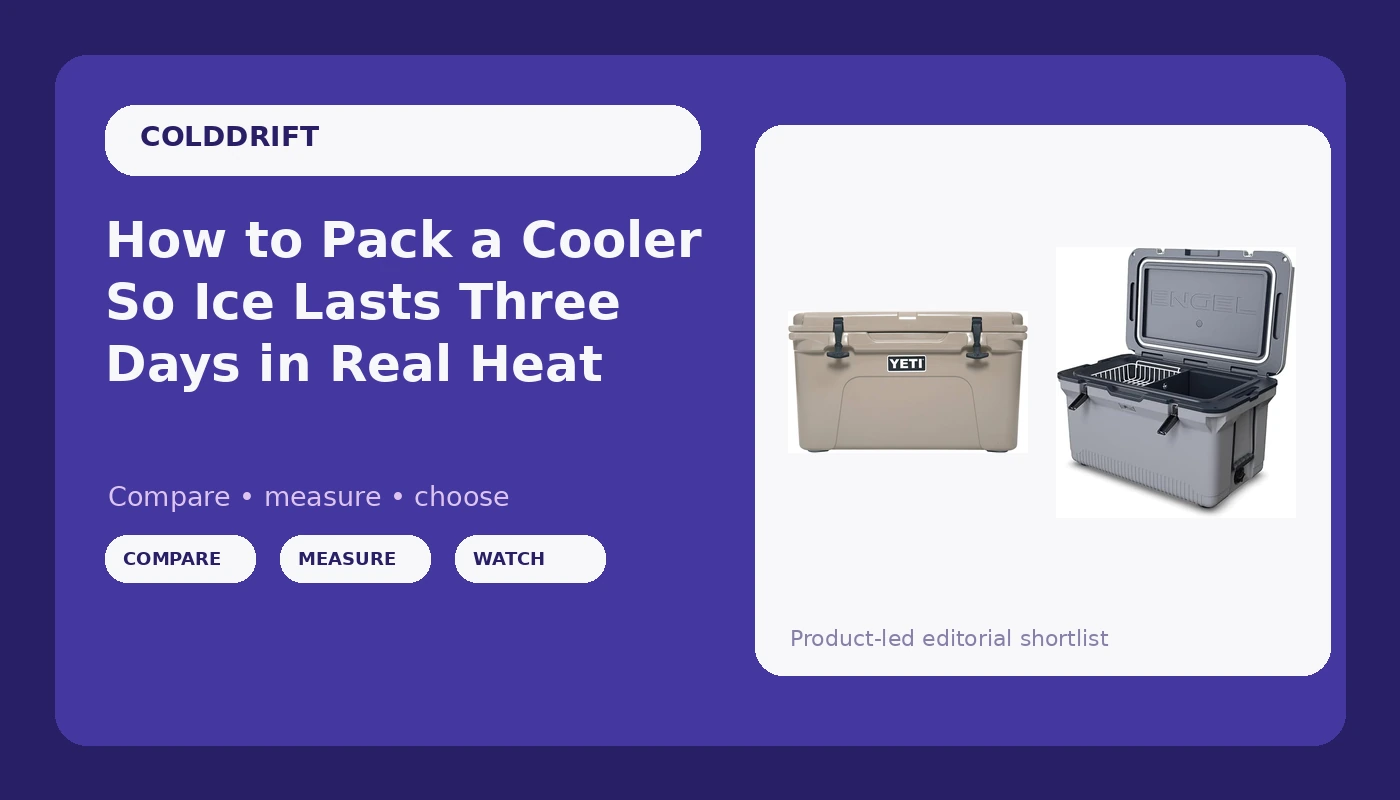
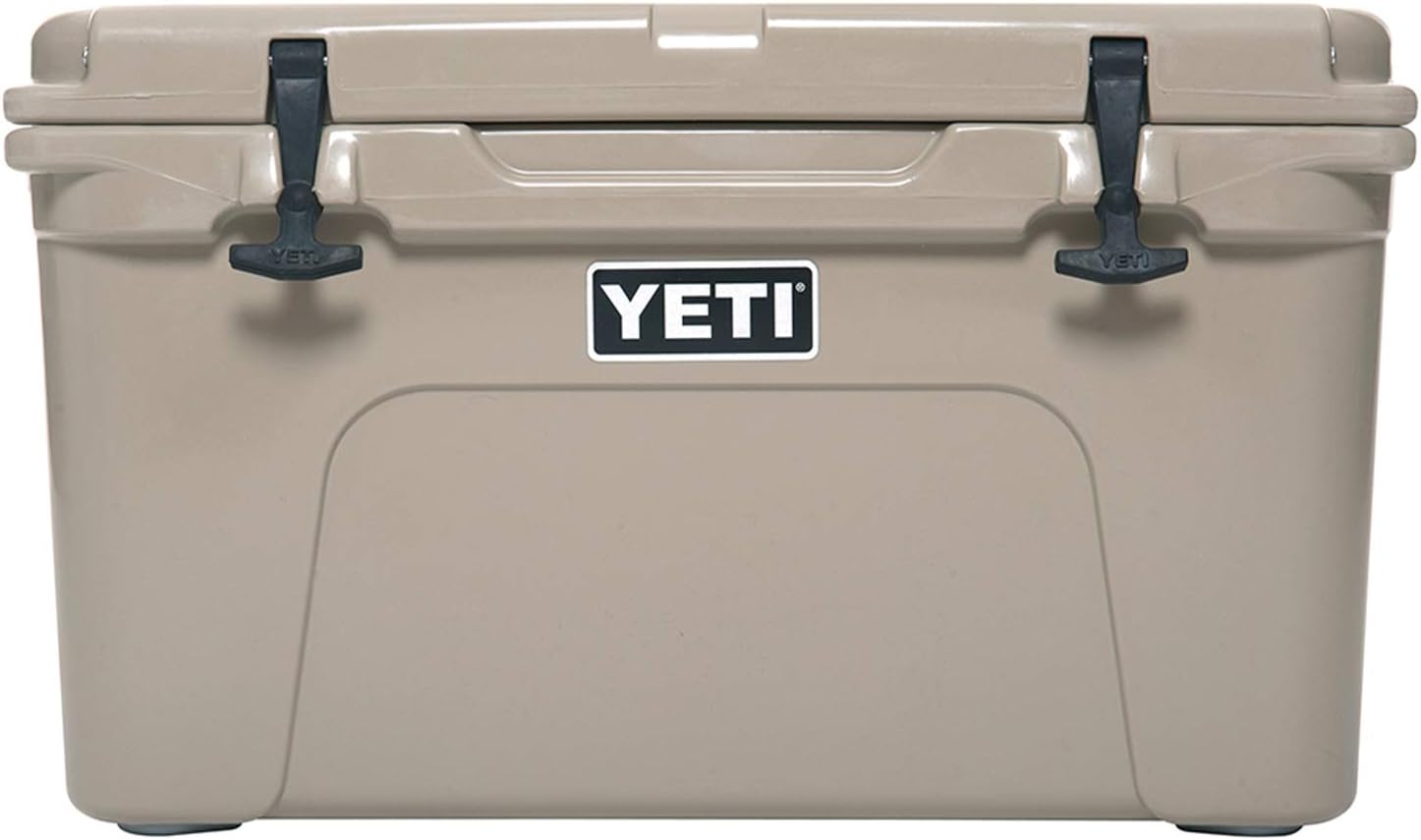
Rotomolded benchmark: YETI Tundra 45 Cooler
 Visit on Amazon →
The Tundra 45 is the benchmark for a reason. Rotomolded in one piece, so the walls, the base, and the rim are a single continuous shell instead of a lid and a liner that can separate on you. The hinge is the part I never think about, which is the highest compliment I can give a hinge. And the gasket seals clean and cold, which is the whole game.
Forty-five quarts is the honest size. Big enough for a day boat with two or three people and a limit of fish, small enough that I can still lift it by myself when it is loaded. Check current Amazon price.
Flaws but not dealbreakers: it is heavy empty, and it is the expensive way to buy ice retention. You are paying for the shell, the seal, and the fact that it will still be a cooler in ten years. If you fish, camp, or tailgate more than ten days a year, that math works. If you use a cooler twice a summer for drinks, it does not.
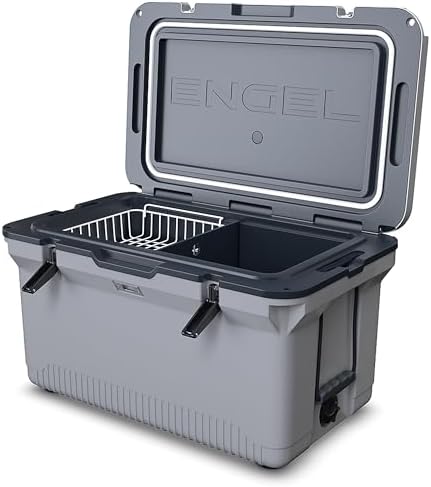
Big-volume dark horse: ENGEL 60 QT Ultra-Light Injection Molded Cooler - Ice Chest Keeps Ice up to 7 Days - Cooler Includes Wire Basket, Divider and Built-in Bottle Opener
 Visit on Amazon →
Engel is the dark horse in my lineup. Injection molded, so it is dramatically lighter than a rotomolded box of the same size, and that matters at the end of a long day when you are the one carrying it up the dock. The manufacturer rates it for ice up to 7 days, which is exactly the claim my log exists to check.
Sixty quarts is a lot of box. That is the tradeoff. The volume is great for a family weekend or a tailgate, and it is a liability if you load it half full, because air is the enemy of ice. Fill it or downsize. The dry storage is excellent, and the wire basket, the divider, and the built-in bottle opener are the kind of details that make a box easy to live with.
Flaws but not dealbreakers: the latches are awkward. They work, but they are not the one-handed slam you get on the Tundra, so I check them every trip before the lid goes down for good. Check current Amazon price.
The packing and loading workflow
Ten steps, in order. This is the part that decides your weekend.
Step one: pre-chill the liner. The night before, put a bag of ice or a few frozen water bottles in the empty cooler and shut the lid. Dump the melt water in the morning. A warm liner eats the first several pounds of ice before you even leave the driveway.
Step two: block ice on the bottom, cube on top. Block ice melts slowly and keeps working for days. Cube ice chills fast and fills the gaps around food. Big block on the floor, cube packed around and over it. If you cannot find block ice, freeze gallon jugs and use those.
Step three: fill the empty space. Air is what kills ice. Aim for two-thirds ice and one-third contents, and if the box is not full, fill the gap with a towel or a frozen jug. A half-empty cooler is a cooler that quits early.
Step four: freeze anything that can be frozen. Meat, water bottles, juice, soup. Anything you freeze is ice you also get to eat later.
Step five: load cold food, not warm food. Anything that goes in should come out of the fridge cold. A warm casserole is a heater with a lid on it.
Step six: batch your openings. Every time the lid comes up, cold air falls out and warm air falls in. One opening in the morning, one at dinner. That discipline is worth more than any feature on the box.
Step seven: leave the plug closed. Cold meltwater at the bottom is cold mass, and it slows the ice above it. Leave it. The exception is a boat, where sloshing water soaks your gear, so drain it and top off with ice when you do.
Step eight: shade beats technology. A wet towel over the lid, a reflective cover, or a spot under the truck bed cover. Direct sun on a dark lid is a cooler working against itself. On a 90-degree day, this is the difference between ice on Sunday and soup on Saturday.
Step nine: log it. Write down the ice level and the inside temperature at the same time each morning. Three days of that tells you what your box actually does, and it catches a gasket that went bad in July instead of during a trip in August.
Step ten: lift the box before you commit. Size honestly. A cooler you cannot carry when it is full is a dock ornament, no matter how good the ice retention number is.
Where coolers fail, and how to catch it early
Three failure points, in the order they show up.
The gasket is the whole game. Close the lid on a dollar bill and pull. There should be drag. If the bill slides out, the seal is not sealing, and every other spec on the box is decoration. Run that test on all four sides.
The latches are the second failure point. Rubber straps beat plastic clips on the trail because they keep tension even when the box flexes. If the lid pops open on a rough road, the cooler is lying to you about its ice life.
The drain plug is the third, and it is the one everybody forgets. Two inches of water in your driveway, one hour, then look for a wet ring. I learned that lesson the hard way and lost a full day of ice on a trip I had planned for a month.
Hinges round out the list. On a rotomolded box, the hinge is usually a molded-in pin that will outlast the cooler. On an injection molded box, open the lid one-handed a few times and watch whether it racks or flexes. If it does, be gentler with it.
What this all costs
I am not going to quote you a sticker, because prices move and your job is to check the current number. Check current Amazon price on both boxes before you decide.
What I will tell you is how to think about it. Rotomolded is the expensive way to buy ice retention. Injection molded is the lighter, cheaper way. The question is not which one is better, it is how many days a year you will actually use it.
More than ten days a year of fishing, camping, or tailgating, and the rotomolded box earns its price. A handful of picnics and one tailgate, and you are paying for a shell you will never abuse. Ice is not free either, so a box that holds ice one extra day is worth real money over a season. That is the math: cost of the box, plus cost of the ice, divided by the trips you actually take.
Coolers that did not make this article
A few categories I skip on purpose.
Thin-wall picnic boxes with cupholders are lunch boxes. If it has cupholders molded into the lid, it is not a cooler, it is a seat with a lid, and no amount of ice will save it on a hot day.
"5-day ice" stickers on cheap boxes are optimistic at best. That claim usually assumes you never open the lid, never put warm food inside, and never leave the box in the sun, which is not how anybody uses a cooler.
Budget boxes still have a place. If your version of a cooler is a Saturday picnic where the potato salad needs to stay honest for six hours, buy the budget box and put the rest of the money into ice. That is a real use case, and it does not need a rotomolded shell.
What none of those boxes get is a spot in my three-day log. Show me ice on Sunday, or show me a different cooler.
The bottom line
Ice retention is the only spec that matters. Everything else is a handle and a hinge. Pre-chill the box, pack it full, put block ice under cube ice, keep the lid shut, keep it out of the sun, and log what happens. Do that and you will know in one weekend whether the cooler in your garage is a cooler or a promise.
The YETI Tundra 45 is the benchmark if you will use it hard and often. The Engel 60 QT is the dark horse if you want volume and a box you can actually carry. Either way, the test is the same, and it starts the night before you leave.