I have been guiding on Lake Superior for fifteen years, and in that time I have watched a lot of walleye, a lot of sandwiches, and one client's insulin go into coolers that promised more than they could deliver. A rolling cooler is a specific tool. It is for the parking lot, the gravel path, the beach, and the tailgate where you cannot park beside the table. Wheels buy you distance, and they cost you insulation, and that is the entire trade in one sentence. This rolling cooler comparison covers four wheeled units across three very different price classes, and I will tell you which one fits which job.
The reason I care about the seal more than the sticker on the front: a cooler is a promise, and most of them lie a little. A lid that does not close clean and cold is not a cooler, it is a plastic box with a handle. So when I look at a wheeled unit, I look at the gasket first, the latches second, the drain plug third, and the wheel clearance fourth. Capacity and price come after that, because a cooler you cannot move when it is full is a dock ornament.
Related: Rotomolded Vs Injection Molded Coolers: What The Shell Actually Does
For most people reading this, the Igloo Trailmate 52 Qt Roller is the pick, because big wheels, a real handle, and a 52 quart body handle actual food on actual terrain. If the budget is tight and the trip is a picnic, the Igloo Tag Along Too is the honest cheap answer. The INSMEER 2-in-1 is a can hauler with a table on top, and the Coleman Classic Series is a hard box with a claim on the label that you should test yourself.
<img src="/images/products/B0CPM9L87M.jpg" alt="Igloo Tag Along Too Coolers
Rolling Ice Chest" width="340" style="border-radius:8px;max-width:340px;width:340px;height:auto;max-height:420px;object-fit:contain"> Igloo Tag Along Too Coolers
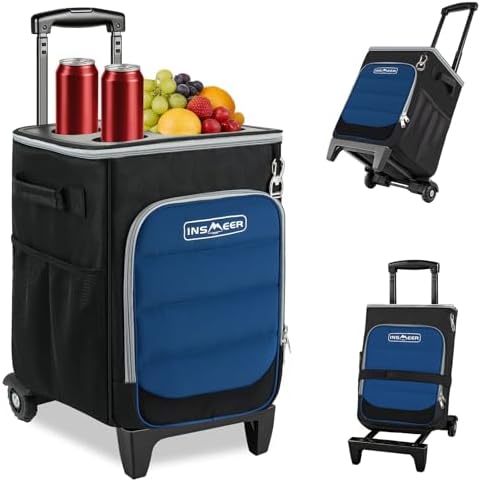
INSMEER 2-in-1 Rolling Cooler with Wheels
60 cans of space in a collapsible body, hard top doubles as a table, best capacity per dollar here
Soft sides do not hold cold like a hard box, zippers are the weak link, and it has cupholders
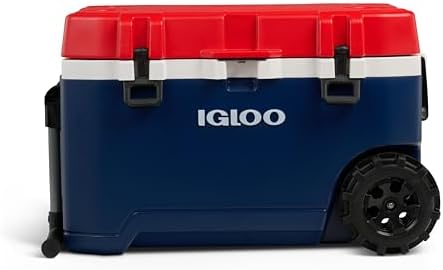
Igloo Trailmate 52 Qt Roller Cooler, Sportsman
Oversized wheels and a long handle that clears gravel, 52 quarts of real capacity
Heavy once it is loaded, eats trunk space, the most expensive unit in this group
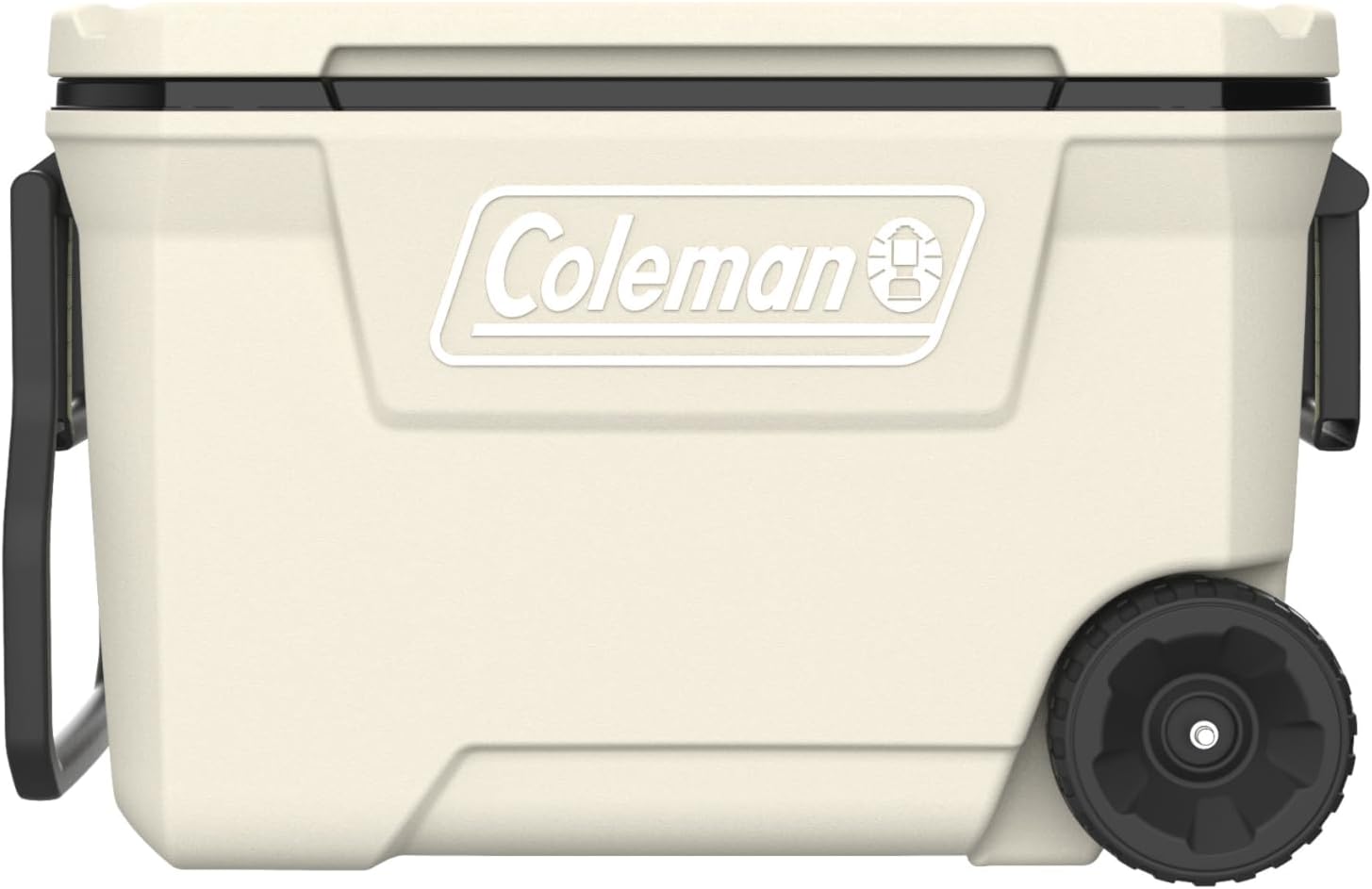
Coleman Classic Series Insulated Portable Rolling Cooler
Hard shell, leak resistant build, the Coleman name and a five day ice claim on the label
Plastic hardware and latches, and that five day claim needs your own temperature log
Prices and availability were captured from Amazon Creators API and may change.
What actually matters on a wheeled cooler
Start with the gasket. Run a finger around the lid channel and look for a rubber seal that sits evenly with no gaps at the corners. A warped gasket is a cooler that lies to you, and on a wheeled unit the lid takes more abuse than on a stationary box because the whole thing gets dragged over curbs and root systems. If the seal looks flat and cheap, the ice will be gone by Saturday morning.
Then the latches. Rubber straps and cam latches beat plastic clips on a rough road, every time. I have lost a day of ice because a latch popped open on a washboard gravel road outside Two Harbors, and I have never made that mistake twice. If the latches feel like they would let go on a bump, they will.
Then the drain plug. Test it in your driveway with water, not on the boat ramp with melted ice running into your cooler full of food. A plug that seeps is worse than no plug, because you stop paying attention to it.
Then the wheels. Small hard casters are fine on a concrete patio and useless on sand, gravel, and the crushed rock shoulder of a north shore pullout. Bigger wheels with some width roll over stuff. This is the single biggest difference between the four coolers below.
Then capacity, and be honest about it. A cooler packed to the lid with ice has no room for food, and a cooler packed with food has less ice than you think. Size for the trip you take, not the trip you describe at the tailgate.
Igloo Tag Along Too: the picnic cooler on wheels
This is the entry point, and it does not pretend otherwise. It is a hard shell picnic style cooler on wheels, which means a small body, a simple lid, and a handle you pull behind you on the way to a picnic table. For a family lunch, a few drinks, and a bag of ice, it works, and it rolls instead of hanging off your forearm.
Where it wins is weight and money. You can lift it into a trunk with one hand when it is empty, and it does not punish you for leaving it in the garage for three months. For a tailgate or a beach day where the food is coming out within a few hours, that is the whole job. If you want the cheapest thing in this comparison that still counts as a cooler with a lid and a handle, this is it.
Where it loses is the same place every small hard shell loses: insulation depth. The walls are thin because the cooler is light, and thin walls mean the ice goes early. Do not buy this for a three day trip and expect a Sunday block of ice, and do not buy it for a limit of walleye on a ninety degree afternoon. Buy it for potato salad, and it will keep the potato salad honest.
INSMEER 2-in-1: the can hauler with a table on top
The INSMEER is the odd one in the group, and I mean that as a description, not an insult. It is a collapsible soft sided cooler on wheels with a hard top, and that hard top has two cup holders in it. Sixty cans of stated capacity is a lot of beverage for the money, and the flat lid gives you a surface to set a plate on when the picnic table is already full.
The soft sided design is the compromise. Soft walls fold, which is why this thing collapses for storage, and soft walls also move cold air differently than a rigid foam box. The company claims the liner is leakproof, and that is the claim to verify with water in your driveway before you trust it in a trunk. I would treat this as a beverage and day trip cooler, not a fish cooler, and not a cooler you leave in the sun all afternoon with a bag of ice in it.
I will say the thing I always say about cupholders on a cooler. If a cooler has cupholders molded into the lid, the marketing department wrote the spec sheet. That does not make it a bad product. It makes it a picnic and beach product, which is exactly what the listing says it is. Buy it for the crowd and the cans, not for the ice log.
Igloo Trailmate 52 Qt: the one that handles gravel
This is the cooler in the group I would actually drag to a boat ramp. The Trailmate is a 52 quart roller in the Sportsman trim, and the reason it costs what it costs is the chassis: oversized wheels and a long handle that keeps the cooler body clear of your heels when you pull it. That matters more than any spec on the label. I have hauled coolers with tiny casters across a crushed rock lot, and by the second trip you are carrying the thing instead of rolling it.
Fifty two quarts is real food capacity. That is a weekend of meals for a small group, or a day of guiding with lunch, drinks, and ice for the catch. The hard body takes a beating and the lid gives you a seat when you need one, which is the quiet advantage of a rigid box over a soft bag.
The cost is weight and space. Loaded, this is a two hand object, and it will eat a third of a small trunk. If you fish, camp, or tailgate more than ten days a year, that is a fair trade. If you are looking for something to toss behind the seat of a sedan for a picnic, it is more cooler than you need.
Coleman Classic Series: the budget box with a big claim
The Coleman Classic Series rolling cooler is the value play for anyone who wants a hard shell, wheels, and a recognizable name without paying Trailmate money. It is a leak resistant insulated hard cooler on wheels, and the listing claims it keeps ice up to five days. I have heard that number from cooler labels for twenty years, and I will tell you what I tell every client: treat the number as a starting point, not a fact, and log your own ice.
What the Coleman gets right is the basics. Hard shell, drain plug, a handle that pulls, and a price that sits between the picnic Igloo and the Trailmate. The brand has been making cheap coolers for a very long time, and parts and replacements are not a treasure hunt.
What it gets wrong is hardware. Plastic latches and plastic hinges are the first things to fail on a budget cooler, and a leak resistant claim is not a leakproof guarantee. Test the drain plug, test the lid seal, and check the latches before a long drive. If you are careful with it and you are not asking for a bear proof box, it will do a weekend.
Where each one loses
Every wheeled cooler loses something, and here is the honest ledger. The Igloo Tag Along Too loses on ice life because of insulation depth. The INSMEER loses on cold retention because soft walls and zippers are not a gasket and a latch, and it gains a gimmick in the cupholders. The Igloo Trailmate loses on weight and price, because big wheels and a 52 quart body are not free. The Coleman loses on hardware and on a five day claim that I would not repeat without my own temperature log.
The pattern underneath all four is the same. Wheels are a convenience feature, and convenience features get paid for somewhere, either in money, in weight, or in ice. There is no wheeled cooler that is also a rotomolded ice box, and anyone who tells you otherwise is selling something.
Which one to buy
If you take real trips, buy the Igloo Trailmate 52 Qt. Big wheels, real capacity, a body that survives a gravel road, and enough room for food and ice at the same time. That is the one I would put in the truck for a three day run.
If the trip is a picnic, a tailgate, or a beach afternoon and the budget is the point, buy the Igloo Tag Along Too. It rolls, it holds a lunch, and it does not pretend to be a fish cooler.
If you are hauling drinks for a crowd and you want a flat surface for plates, the INSMEER 2-in-1 is the right shape for that job, as long as you accept that a soft sided bag is a day cooler.
If you want a hard shell, wheels, and a mid range price, and you are willing to test the seal and the plug yourself, the Coleman Classic Series is a reasonable buy.
Before you load it
Fill it with water in the driveway and look for seepage at the plug and the lid. Ice the cooler down the night before a trip, because a cold box holds ice longer than a warm one. Pack ice in blocks when you can get them, since a block outlasts cubes by a wide margin. And size honestly, because the cooler you cannot lift when it is full is the cooler that stays in the garage.
That is the whole test. Seal, latches, plug, wheels, and the truth about how you actually use the thing. Get those five right and you will not be the person on the dock at noon on day two, staring into a puddle of water and a warm limit.