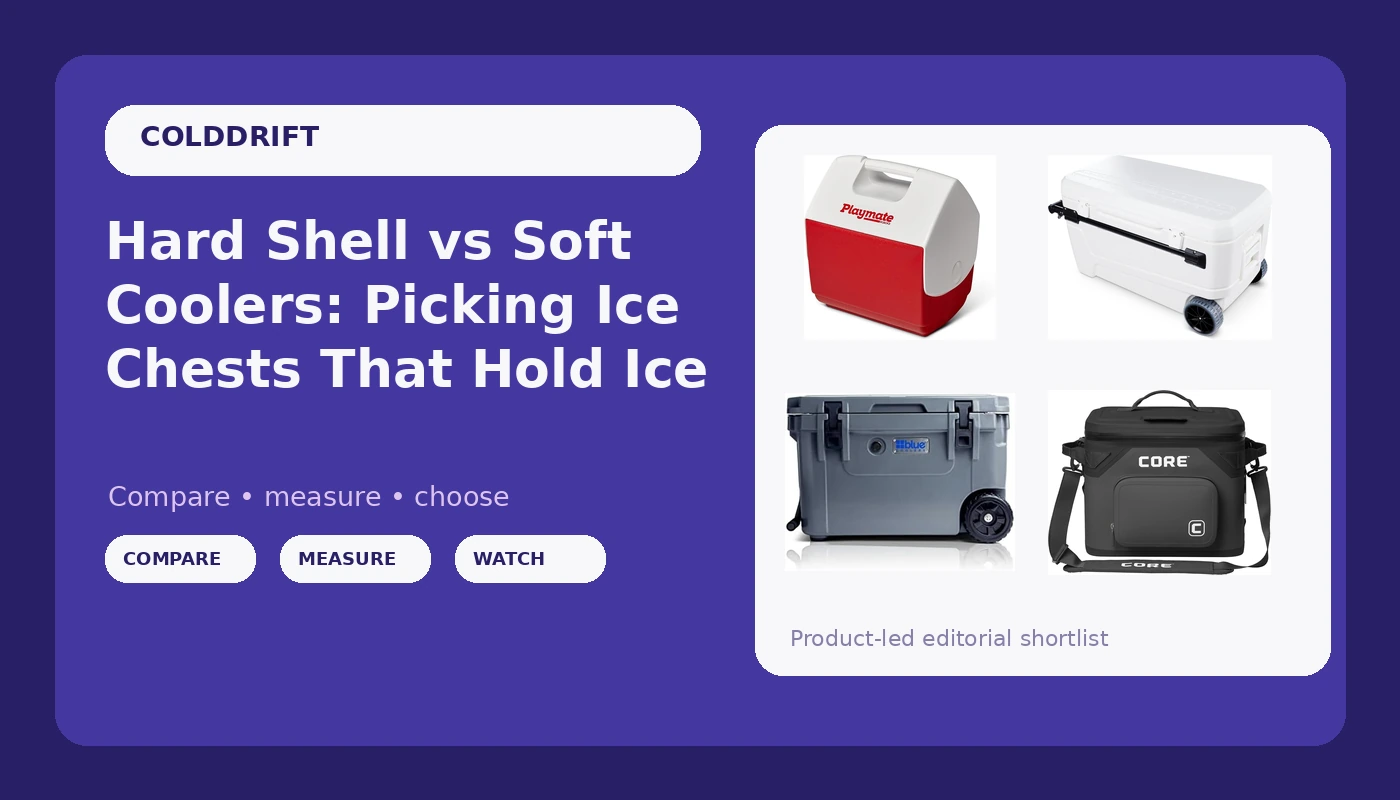
A cooler is a promise about time. How long the ice holds, how long the food stays honest, how long you can stay out before somebody has to drive to town for another bag. Shopping for coolers for camping and tailgating gets confusing fast because the shelf mixes four different jobs into one category: compact hard-shell chests built for a single day, big wheeled boxes built to feed a crowd, soft-sided bags built to ride behind a truck seat, and roto-molded tanks built for multi-day trips. The spec sheet rarely tells you which one you are looking at, and the marketing language on the box rarely tells you the truth. What follows is a plain explanation of how four popular options differ, what each one is genuinely built for, and how to choose without paying for capacity or ice life you will never use.
Related: How to Pack a Cooler So the Ice Lasts Through Day Three →
Quick answer
Match the cooler to the length of the trip and the weight you can actually lift when it is full. A soft-sided bag or a compact hard-shell chest covers day trips and tailgates. A large wheeled chest covers a crowd at a base camp. A roto-molded wheeled cooler is the option built for multi-day ice retention. Capacity is the number people overbuy. Ice retention is the number that decides whether the trip works.
Four useful options
| Model | Best fit | What stands out |
|---|---|---|
| Blue Coolers Ice Vault, 60 Quart Roto-Molded Ice Cooler with Wheels | Multi-day trips where ice life matters most | Roto-molded single-piece construction, wheeled body, and a listing that states ice retention up to 10 days |
| Igloo Maxcold Glide 110Qt Wheeled Cooler | Large groups, base camps, long weekends | 110-quart capacity on a wheeled hard-shell body with MaxCold insulation |
| CORE Magnetic Leak Proof Soft Cooler with Waterproof Zipper | Tailgates, car camping, beach days | Magnetic closure and a waterproof zipper on a soft, portable insulated bag |
| Igloo Classic Playmate Coolers | Day trips, lunches, small loads | Compact insulated hard shell that is easy to carry by hand |
Multi-day ice chest: Blue Coolers Ice Vault, 60 Quart Roto-Molded Ice Cooler with Wheels
The trade-off here is weight. Roto-molded coolers are heavy before you put anything in them, and a 60-quart box full of ice and food is not something you want to carry up a flight of stairs. That is why the wheels matter more than they look like they do on a product page. Treat the stated ice retention as a ceiling measured under favorable conditions, not a guarantee for a cooler sitting in direct sun with the lid opening every twenty minutes. If your trips are two to four days and you want one cooler to do all of them, this is the category where that money goes.
Large-group hauler: Igloo Maxcold Glide 110Qt Wheeled Cooler
Big capacity is a different purchase decision than long ice retention. A 110-quart cooler is for the tailgate with twelve people, the week at the lake with a family, the camp kitchen that has to hold everything at once. It holds a lot of ice, which helps retention simply because there is more cold mass to give up, but the sheer interior volume also means more air to chill and more surface area to lose cold through. Buy this size because you need the room, not because you think bigger automatically means colder. And measure your vehicle before you commit, because a chest this large takes up real space.
Soft-sided option: CORE Magnetic Leak Proof Soft Cooler with Waterproof Zipper
Soft coolers are honest about what they are, as long as you do not ask them to be something else. They will not hold ice for days. They will keep drinks cold through a long afternoon, they will fit where a hard chest will not, and they will not turn into a 70-pound problem at the end of the day. The closure system is the whole story on a bag like this: a magnetic lid with a waterproof zipper is designed to stay shut and stay sealed, which is the failure point on cheap soft coolers. If your trips are measured in hours rather than days, this format is the practical choice, and the hard-shell options in this group are simply overkill.
Day-trip classic: Igloo Classic Playmate Coolers
This is the cooler most households actually need and the one most buyers skip because it looks unambitious. Its job is a lunch, a limit of fish, a twelve-pack, a day on the water. It will not hold ice through a weekend and it is not designed to. What it does well is stay light, fit in a footwell, and cost far less than anything roto-molded. If you already own a big chest for group trips, a small hard-shell like this is the one that gets used on ordinary Tuesdays.
Prices and availability may change. Product images, names, and retailer links are matched to verified listings. No current price, rating, stock status, or measured result is stated here without current evidence.
What roto-molded construction actually changes
Rotational molding means the body and lid are formed as thick, seamless, single-piece shells rather than assembled from thinner panels joined at seams. In practice that changes three things. First, wall thickness: more plastic and more insulation foam between the interior and the outside air, which slows heat transfer. Second, rigidity: a stiff shell keeps the lid seated flat against the gasket instead of flexing and letting air through. Third, hardware: hinges and latches on roto-molded coolers are typically beefier because the cooler is expected to be dragged, sat on, and loaded by people who are not gentle.
Injection-molded coolers, which covers most of the sub-hundred-dollar market, are lighter, cheaper, and perfectly capable of a day trip. The seams and thinner walls are the trade-off, not a defect. If you use a cooler fewer than ten days a year, an injection-molded chest is the sensible purchase and the extra money buys you very little. If you fish, camp, or tailgate through a whole season, the roto-molded option is the one that stops being a compromise.
How to read an ice-retention claim
Ice retention numbers are measured under conditions you will never reproduce. A manufacturer testing a cooler typically starts with a pre-chilled box, fills it with block ice, keeps it closed, and holds it at a moderate ambient temperature. Real trips involve a warm cooler, cubed ice, a lid that opens every time somebody wants a soda, and direct sun on a dark lid. Every one of those factors cuts the number.
So treat any stated retention figure as a ceiling, not a promise. A cooler listed at up to 10 days is telling you it is built for multi-day use, not that you will find ice on the tenth morning. The useful comparison is relative: the roto-molded wheeled chest in this group will outlast the soft bag, and the soft bag will outlast a thin-shelled lunch box. That ranking holds even when the absolute numbers do not.
- Count days, not drinks. A one-day trip and a four-day trip are different purchases.
- Estimate real volume: food, drinks, and ice all take space, and ice takes the most.
- Decide whether you can lift the cooler when it is full. If not, buy wheels or buy smaller.
- Inspect the seal and the closure. A gasket that does not sit flat is a cooler that will not hold ice.
- Check the drain plug before the trip, not during it. A leaking plug drains cold air and meltwater management with it.
Packing and hauling habits that matter more than the spec sheet
- Pre-chill the cooler with a bag of ice the night before, then dump it and reload. Starting cold beats starting warm.
- Use block ice or frozen water bottles for the bottom layer and cubed ice on top. Big chunks melt slower.
- Fill empty air space with towels, newspaper, or more food. Air is what you are fighting.
- Keep the cooler out of direct sun and off hot pavement, and consider a blanket over the lid at a campsite.
- Separate drinks into their own cooler if you can. Every lid opening costs ice, and drinks cause the most openings.
Which option should you choose?
Choose the Blue Coolers Ice Vault, 60 Quart Roto-Molded Ice Cooler with Wheels when your trips run multiple days and ice life is the priority. Choose the Igloo Maxcold Glide 110Qt Wheeled Cooler when volume is the priority and you are feeding a crowd from a base camp or tailgate. Choose the CORE Magnetic Leak Proof Soft Cooler with Waterproof Zipper when you need something portable that fits in a car and covers an afternoon. Choose the Igloo Classic Playmate Coolers when you want a light, simple chest for lunches and single-day outings.
Two limits are worth stating plainly. Retention figures come from manufacturers under controlled conditions, not from a log kept on your trip, and capacity in quarts tells you interior volume rather than how much usable food space you get after ice goes in. Neither number is wrong, but both are easier to trust when you read them as descriptions of intent rather than test results.
The bottom line
The cooler question is really a trip-length question. A compact hard-shell chest or a soft-sided bag handles a day on the water or an afternoon at the tailgate at the lowest weight and cost. A large wheeled chest handles the crowd. A roto-molded wheeled cooler is the one built for trips where the ice has to survive past the second sunrise, and the price reflects that construction. Pick the smallest format that covers your longest regular trip, verify the seal and the drain plug yourself, and spend the difference on ice rather than on capacity you will never fill.