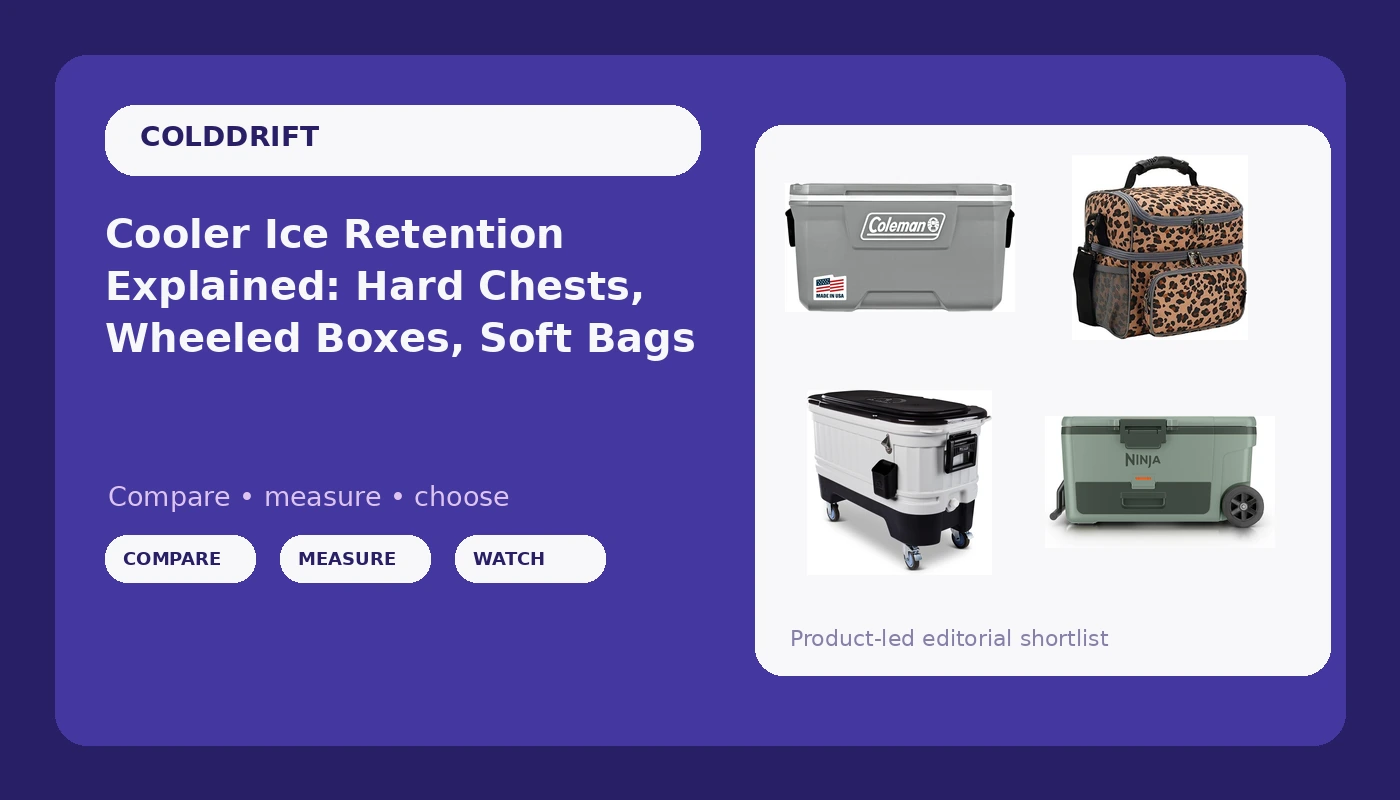
Cooler ice retention is the only specification that decides whether a trip ends with cold fillets or a warm, sad smell in the truck bed by noon on day two. The problem is that the label rarely tells you what you need to know. A 65-quart wheeled chest, a 150-quart budget cooler, a hard party box, and a soft insulated tote all say "insulated," and they mean four different things. This explainer covers what actually drives cooler ice retention, how quart capacity maps to real trips, and where each of four current listings fits.
Related: How to Pack a Cooler So Ice Lasts Past Day Two →
Quick answer
Ice retention depends on insulation thickness and quality, how well the lid gasket seals, how often the lid opens, and how much ice you pack relative to food and drink. Quart capacity describes the size of the box, not how long it holds ice. A wheeled hard cooler such as the Ninja FrostVault 65qt makes a loaded box movable. A budget chest such as the Coleman Classic Series gives you the most volume per dollar. A party-format hard cooler such as the Igloo Polar and Party Bar series suits groups serving drinks. A soft insulated tote such as the FlowFly is a lunch bag for a day, not a multi-day ice chest. Pick the trip length first, then compare gaskets, latches, and drain plugs.
Four cooler styles worth understanding
| Model | Best fit | What stands out |
|---|---|---|
| Ninja FrostVault™ 65qt Cooler with Wheels, Dry Storage, Spanish Moss | Multi-day trips where you load and unload alone | 65-quart capacity, a wheeled base, and a separate dry storage area |
| Coleman Classic Series Insulated Portable Cooler, Leak-Resistant Outdoor Hard Cooler Keeps Ice up to 5 Days, 52/70/120/150 Quart | Base camps and tailgates where volume matters more than peak ice life | Listed in sizes from 52 to 150 quarts; manufacturer states ice retention up to 5 days |
| FlowFly Double Layer Cooler Insulated Lunch Bag Adult Lunch Box Large Tote Bag for Men, Women, With Adjustable Strap,Front Pocket and Dual Large Mesh Side Pockets | Day trips, work lunches, and short outings | Soft double-layer build, adjustable strap, front pocket, two mesh side pockets |
| Igloo Hard Cooler | Polar & Party Bar Series | Insulated Ice Chests | Groups, parties, and beverage service | Hard-sided insulated ice chest format across the Polar and Party Bar lines |
The wheeled hauler: Ninja FrostVault™ 65qt Cooler with Wheels, Dry Storage, Spanish Moss
The honest trade-off with any large hard cooler is weight. Ice is heavy, and a 65-quart box packed for a weekend is a two-person lift once it is full. Wheels do not change the ice retention, they change whether you actually take the cooler with you instead of leaving it at home. The dry storage area matters more than it sounds, because keeping bread, chips, or a phone out of the meltwater is the difference between a packed lunch and a soggy one. What wheels do not solve is space: a wheeled 65-quart chest takes up real room in a truck bed or a boat deck, so measure before you commit.
The budget chest: Coleman Classic Series Insulated Portable Cooler, Leak-Resistant Outdoor Hard Cooler
This is the category most people actually buy, and the reason is simple arithmetic: you get far more internal volume for the money than you do with a premium rotomolded box. Treat the "up to 5 days" figure the way you would treat any manufacturer number. It assumes a closed lid, a favorable ambient temperature, and a cooler that is not being opened every twenty minutes for another drink. Open it constantly in full sun on a 90-degree day and you will not see that number. What you will still have is a large, cheap box that holds a lot of ice, which is exactly what a base camp or a tailgate needs.
The soft tote: FlowFly Double Layer Cooler Insulated Lunch Bag
Soft-sided bags get judged unfairly because people compare them to hard chests. They are not the same tool. A double-layer soft tote has no thick foam wall, no gasket seal, and no drain plug, so it holds cold for hours, not days. What it does have is a strap, light weight, and enough pockets to keep a sandwich, a bottle, and a bag of ice separated for a workday or a half-day outing. If your cold storage need ends when you get back to the truck, this is the right shape of bag. If it needs to survive two nights, it is the wrong one.
The party chest: Igloo Hard Cooler | Polar & Party Bar Series | Insulated Ice Chests
Group coolers live a different life than fishing coolers. They get opened constantly, they hold drinks rather than fillets, and the priority shifts from maximum ice days to easy access and enough volume for a crowd. That is a legitimate use case, but it is worth being clear about it: a cooler optimized for grabbing cans all afternoon will not be the one you want for keeping a catch cold for three days. Buy it for the party, not for the expedition.
Prices and availability may change. Product images, names, and retailer links are matched to verified listings. No current price, rating, stock status, or measured result is stated here without current evidence.
What ice retention actually measures
Ice retention is a measurement of time: how long a cooler keeps ice frozen under a defined set of conditions. Manufacturer numbers generally assume a partially filled box, a closed lid, and a moderate ambient temperature. Real trips break all three assumptions. Every lid opening dumps the cold air pooled at the bottom, and every warm item you add has to be chilled by ice you were counting on for later.
Three physical details drive most of the gap between a cheap chest and a premium box:
- Insulation and wall thickness. Single-piece rotomolded shells let a manufacturer build in thicker foam with fewer seams for heat to travel through. Thin injection-molded walls and a hollow lid lose that race.
- The lid gasket. A rubber gasket creates the cold-air seal between lid and body. If it is warped, pinched, or missing, you own a box with a lid that lies to you.
- Lid fit and latches. A lid that flexes or a latch that pops open on a rough road turns a two-day cooler into a one-day cooler.
Usage matters as much as construction. Pre-chilling the box, using block ice instead of cubes, parking it in shade, and limiting openings will extend ice life more than any single specification on the label.
Matching capacity to trip length
Quart ratings describe internal volume, not ice life. A practical planning rule is to budget roughly two quarts of capacity per person per day for food and drink, then add ice on top of that. A two-person, three-day trip therefore lands in the 50 to 60-quart range before you count the ice itself, and ice takes up space. Filling a multi-day cooler about two-thirds with ice and one-third with contents is a workable starting point.
Weight is the other half of capacity. A large chest loaded for a weekend is either a two-person lift or a wheeled problem. That is the practical reason wheeled coolers exist, and the practical reason a 150-quart box is a poor choice for one person who has to move it alone.
- Count days, not meals. A single day needs a soft tote; three days needs a chest that still has ice on day three.
- Count people, then multiply. Roughly two quarts per person per day for food and drink, plus the ice volume.
- Decide who lifts it. If you load and unload alone, a wheeled cooler or a smaller chest is the honest answer.
- Inspect the seal before you commit. Close the lid and check that the gasket sits flat with no gaps, pinches, or twists.
- Plan the ice. Block ice for base camps, cubes for drinks, and freeze whatever food you can before it goes in.
Practical guidance before you buy
- Pre-chill the cooler with a bag of ice the night before a trip. A warm box eats your first day of ice for free.
- Keep it out of direct sun and off hot pavement. Shade and airflow do real work on ice life.
- Test the drain plug at home with water before the trip, not during it. A leaking plug costs you a day.
- Match the ice form to the job: blocks last longest, cubes chill drinks fast, crushed ice melts quickest.
- Buy the size you can actually move when it is full. A cooler you cannot lift is a cooler you leave behind.
Which option should you choose?
Choose the Ninja FrostVault™ 65qt Cooler with Wheels, Dry Storage, Spanish Moss when you take multi-day trips and want a full-size chest you can move without a second person, and when a separate dry compartment matters for bread, phones, or paperwork. Choose the Coleman Classic Series Insulated Portable Cooler when budget and volume are the priorities and you want the flexibility of picking among 52, 70, 120, and 150-quart sizes. Choose the FlowFly Double Layer Cooler Insulated Lunch Bag when your cold storage need lasts a workday or a single outing and you want something you can carry on a shoulder strap. Choose the Igloo Hard Cooler, Polar and Party Bar Series when the job is serving drinks to a group and easy access beats maximum ice life.
The caveat that applies to all four: nobody can tell you how many days a specific cooler will hold ice in your truck, on your trip, without a temperature log, and listings do not publish one. Treat manufacturer retention figures as an upper bound under favorable conditions, and plan a margin of extra ice for the first trip.
The bottom line
Cooler ice retention is a product of construction and habits, not a single number on a box. Insulation and a clean gasket set the ceiling; how often you open the lid and how much ice you pack determines where you land underneath it. Size the cooler to the trip and to your own lifting ability, decide whether you need wheels or a shoulder strap, and treat every "holds ice for days" claim as a best case rather than a promise. Pick the format that matches the trips you actually take, and the ice will take care of the rest.