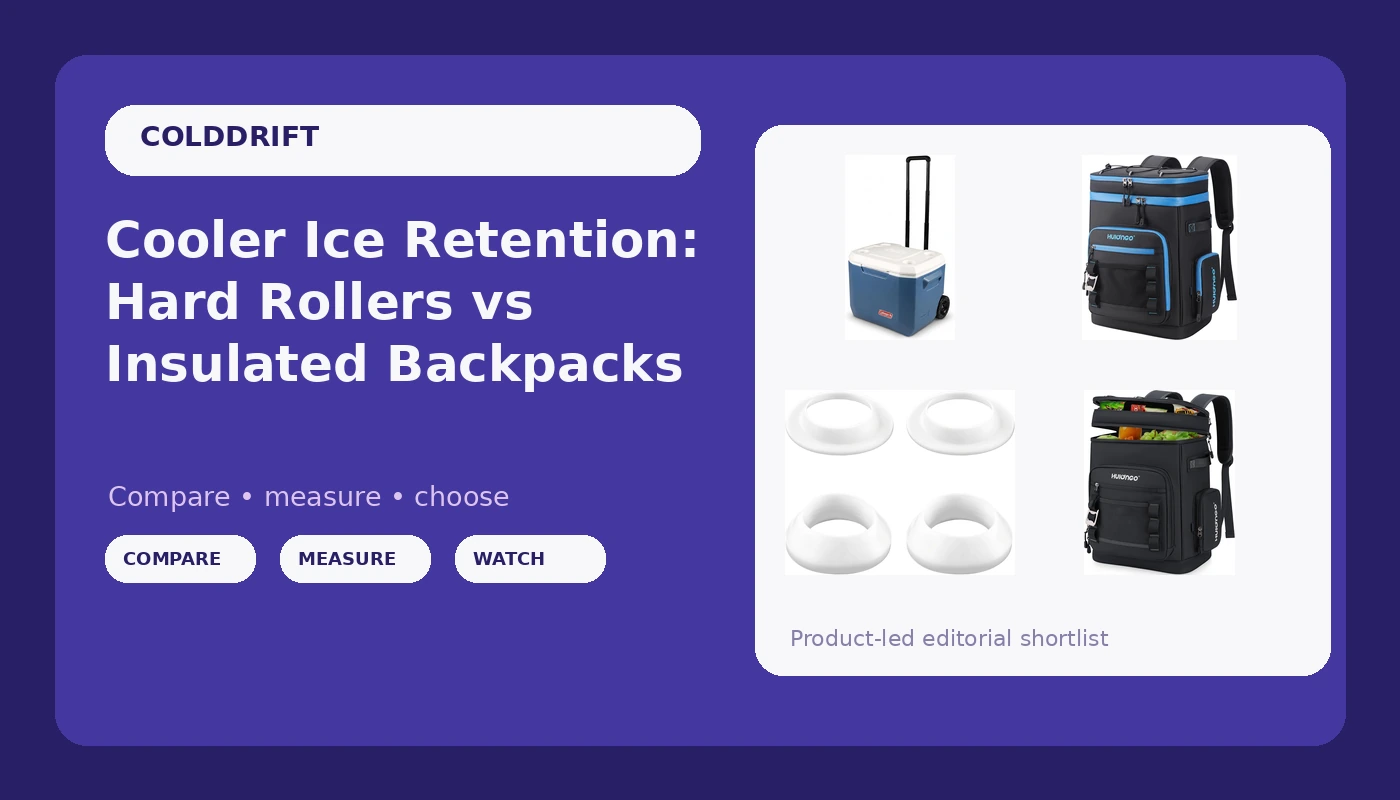
Cooler ice retention is the only spec that survives contact with a real trip. The handle, the hinge, the molded-in cupholders, all of it is decoration until the ice is gone and the food is warm. If you are shopping for a cooler right now, the problem is not a shortage of options. It is that the numbers printed on the side of the box are written by people who want you to buy, not by people who want your catch still cold on Sunday morning. This guide covers four listings: a wheeled hard cooler with extra-walled insulation, two separate listings of the same 30L insulated cooler backpack, and a small silicone gasket that is worth understanding even though it does not belong on a cooler.
Related: How to Pack a Cooler So Ice Lasts Past Day Two →
Quick answer
Buy the wheeled hard cooler when the trip runs longer than a day and the cooler stays on the ground, in the truck bed, or on the boat deck. Buy the 30L insulated backpack when you are the one carrying it, on a hike, a paddle, or a long walk from the parking lot. Neither one will hit a printed ice claim if you load it warm, open it every twenty minutes, and park it in direct sun. Ice retention is decided by wall thickness, the seal at the lid, how much cold mass you start with, and how often the lid comes off, in roughly that order.
Four useful options
| Model | Where it fits | What stands out |
|---|---|---|
| Coleman Xtreme Rolling Cooler with Wheels | Multi-day trips with a heavy load | Extra-walled insulation and a wheeled hard-sided body; the maker claims ice up to 5 days |
| Hulongo Large Waterproof Insulated Cooler Backpack, 30L, 48Cans | Day trips and short overnights you carry yourself | 30L insulated pack with a waterproof construction claim and a 48-can capacity rating |
| Drainage Seal,Universal Basin Drain Gasket Replacement Parts | A worn sink drain, not a cooler | Thickened silicone ring with top and bottom washers, sold as two sets |
| Hulongo Large Waterproof Insulated Cooler Backpack, 30L, 48Cans (second listing) | Same job as the pack above | The same 30L pack offered under a separate listing |
The heavy-load option: Coleman Xtreme Rolling Cooler with Wheels, Extra-Walled Insulation Keeps Ice up to 5 Days, Portable Wheeled Hard Chiller
The trade-off here is weight and footprint. A hard cooler with thick walls does not collapse, does not go in a canoe pack, and does not get carried a mile down a trail. It is also the shape that holds the most cold mass for the money, because the walls have room to be thick and the lid has a large sealing surface. Treat the five-day figure as a manufacturer claim under ideal conditions, which means pre-chilled contents, a full load, shade, and a lid that stays shut. Real trips involve warm drinks going in and a lid opening all afternoon, and that is what shortens the number.
The carry option: Hulongo Large Waterproof Insulated Cooler Backpack, 30L, 48Cans
Soft-sided insulation is thinner than hard-sided insulation, so the honest expectation is a day, not a weekend. That is still the right answer for a lot of trips. A pack that keeps drinks cold from morning to evening and rides on your back beats a hard cooler that keeps ice for three days and stays in the truck because nobody wants to carry it. The other thing a backpack does well is seal against rain and splash, which is what the waterproof claim is about. It is not a claim about ice life.
The small-part reality check: Drainage Seal,Universal Basin Drain Gasket Replacement Parts,Thickened Silicone Sealing Ring for Bathroom Sink Drain Stopper,Includes Top and Bottom Washers Seals (White-2 Sets)
To be clear about what this is: it is a basin drain gasket, and it will not fit a cooler drain plug or a cooler lid channel. If you came here hunting a cooler gasket, this is not it, and forcing a sink ring into a cooler is how you end up with a leak and a story. What the listing does illustrate is why gasket material matters. Silicone holds up to temperature swings and repeated compression better than a stiff, cheap rubber ring, and a seal that has gone hard or warped is the reason a cooler with good walls still disappoints. Check the seal on whatever you buy before the trip, not during it.
The second listing: Hulongo Large Waterproof Insulated Cooler Backpack, 30L, 48Cans
Nothing about the pack changes between the two listings, so do not read this as a choice between two different coolers. It is one product, two entries, and the same set of expectations applies: a day of cold, not a weekend of it. If you are comparing the two, compare what each offer shows you at the moment you buy, and ignore any assumption that a second listing means a second, upgraded version.
Prices and availability may change. Product images, names, and retailer links are matched to verified listings. No current price, rating, stock status, or measured result is stated here without current evidence.
How ice retention actually gets decided
Four things control how long ice lasts, and only one of them is printed on the box.
The first is insulation thickness and the material inside the walls. Thick foam slows heat transfer, and a hard-sided cooler can afford more of it than a soft pack. This is why the same 20 pounds of ice behaves differently in a wheeled hard cooler than in a backpack.
The second is the lid seal. A gasket that seats cleanly all the way around keeps cold air where it belongs and keeps warm, wet air out. A warped or hardened gasket turns a good cooler into a box with a lid-shaped suggestion on top. Run a finger around the channel before you buy, and check it again before every season.
The third is cold mass relative to contents. Ice cools the food and the air in the box, so a cooler that is two-thirds full of cold items holds far longer than one with a single bag of ice rattling around in empty space. Pre-chilling what goes in does more for ice life than any accessory.
The fourth is open time. Every lid lift dumps the cold air that settled at the bottom. A cooler opened twenty times on a hot day will lose ice faster than the same cooler opened five times, no matter who built it.
Drain plugs deserve a mention as the weak point on hard coolers. A plug that seeps is a cooler that lies to you, and it is the cheapest failure to prevent, because you can test it in the kitchen with water before you load it with food.
What the numbers on the cooler box really mean
Ice-retention claims are written for a test you are not running. The standard behind a multi-day figure involves a controlled starting temperature, a set amount of ice, a closed lid, and a stable ambient temperature. Your trip involves a warm case of drinks, a lid that opens, and a boat deck in the sun. The claim is not a lie in the lab; it is just not a promise about your Saturday.
Capacity ratings have the same gap. A stated can count usually assumes cans and ice only, packed tight with no food and no air. Add a bag of frozen walleye, a jug of coffee, and a loose bag of ice, and the real capacity drops. Size the cooler to the honest load, not to the number on the label.
Watch for the word waterproof on a soft cooler. It generally describes the outer shell and zipper handling rain, spray, and a splash from a paddle, which is a real benefit. It does not describe the ice life of the insulation inside.
And treat any molded-in cupholder as a signal about intent. A cooler with cupholders is designed for a parking lot, not a three-day trip, and there is nothing wrong with that as long as you know which one you bought.
A five-step way to decide
- Write down how many days the trip runs and whether the cooler sits still or rides on your back.
- Estimate the real load in pounds, including drinks, food, and ice, then compare it to the stated capacity.
- Check the lid seal and the drain plug, and confirm both seat cleanly before the trip.
- Decide whether you need a hard body for cold mass or a soft pack for carrying, because you rarely get both.
- Plan the packing order so the coldest items sit low, the lid opens as little as possible, and nothing goes in warm.
Practical guidance for a three-day trip
- Start with a cold cooler, not a room-temperature one. Chill it or load it with a sacrificial bag of ice the night before.
- Fill empty space. Wadded towels or a second bag of ice reduce the air your ice has to cool.
- Keep the cooler out of direct sun and off hot surfaces, including a black truck bed liner.
- Group drinks in one container so the main lid stays shut, and open the whole cooler only at meals.
- Test the drain plug with water at home, and carry a spare seal if the plug has one.
Which option should you choose?
Choose the Coleman Xtreme Rolling Cooler with Wheels when the trip runs more than a day, the load is heavy, and the cooler can stay on the ground or in the vehicle. Choose the Hulongo Large Waterproof Insulated Cooler Backpack, 30L, 48Cans when you have to carry the cold yourself and a single day of ice is enough. Choose either Hulongo listing when you want that pack, since both describe the same 30L product and the difference is which offer is available. Choose the Drainage Seal,Universal Basin Drain Gasket Replacement Parts only if you are fixing a bathroom sink drain, and look elsewhere for a cooler gasket.
The limitation worth repeating is that none of these listings comes with a published, independent ice-retention log for the exact way you use a cooler. Claims are manufacturer claims. The reliable approach is to buy for your real trip length, then verify the seal and the plug yourself before the ice goes in.
The bottom line
For multi-day trips with real weight, a wheeled hard cooler with thick walls is the shape that holds cold longest, and the five-day figure should be read as a manufacturer claim under ideal conditions rather than a forecast. For day trips you carry on your back, a 30L insulated backpack is the practical pick, with the honest expectation of a day of cold and good rain protection. The sink drain gasket is a reminder that seals, not stickers, decide whether any of it works, and that a replacement part belongs in the product it was made for. Size the load honestly, check the seal and the plug before you leave, and the cooler you own will outperform the claim you were sold.