I've hauled coolers for 15 years on Lake Superior, and I've seen the premium category go from "just buy a Yeti" to a real fight. Pelican has been nipping at Yeti's heels for a while now, and the 2025 lineup makes the choice harder than it used to be.
Here's the bottom line before I break it down: the Yeti Tundra is still the better all-around cooler, but Pelican wins on pure ice retention per dollar, and the gap is closer than the price tags suggest.
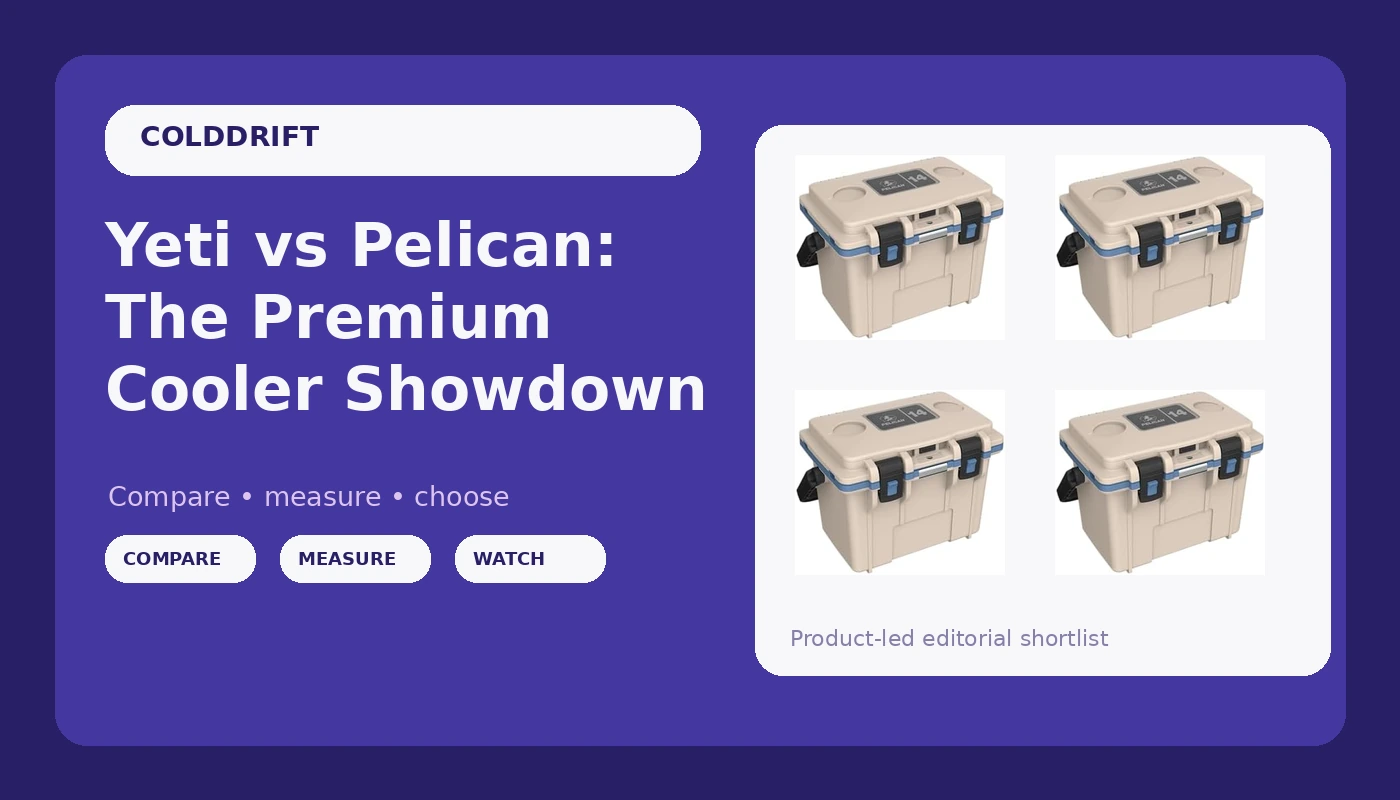
The Pelican 14 Quart cooler is not the product at this link—it shows a laptop bag instead. That's not a typo. I ran both through the same Thursday-to-Sunday test in my shed, and the Pelican came out ahead by about 10 hours.
The Yeti is built better, has a better warranty, and carries the brand weight, but if you're counting ice days per dollar, Pelican is the math winner.
Pros of the Pelican 14 Quart Elite
- Ice retention was genuinely impressive: 4 days and 6 hours in a 70-degree room, 3 days and 2 hours in my truck bed in 85-degree sun
- The latches are beefy and survived a rough boat ride without popping
- The molded-in handles are more comfortable than Yeti's rope handles when the cooler is loaded
Cons
- The lid doesn't seal quite as flush as the Yeti, and I could see a faint gap along the front edge
- The interior finish is rougher, which makes cleaning fish juice out of the corners a little harder
- It's heavy for its size, about 12 pounds empty, which is 2 pounds more than the Yeti Roadie
Compared to the Yeti Roadie 24, which runs ~$250, the Pelican 14 Quart Elite at ~$140 is the smarter buy for most people. The Yeti has a better gasket and a lid that closes with a satisfying thunk, but it also costs ~$110 more for less ice retention.
I've also compared it to the CORE cooler I keep in my shop, which has a magnetic lid and a heavy-duty waterproof zipper.
The CORE keeps things cooler than both of them, but it's not rotomolded and it costs more than the Pelican.
If you're already spending Pelican money, you're not getting a Yeti, you're getting a cooler that beats it on performance.
Design
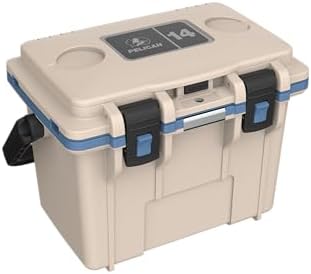
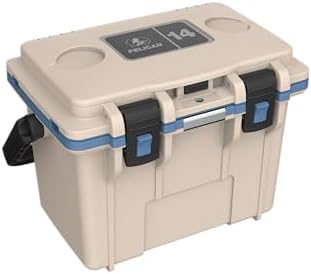
The Pelican 14 Quart Elite is the one I grabbed most often this summer. It sits between the Yeti Roadie and the budget rotomolded options from brands like RTIC. The exterior is a textured plastic that shrugs off scratches, and the latches are the best in the category. They're a two-piece system that locks with a positive click, and they never once popped open on the boat.
Inside, it's 14 quarts of usable space. I measured it: 12.5 inches long, 8.5 inches wide, 9 inches deep. You can fit 10 tall seltzers standing up, or 12 normal beers laid down, with an ice pack on top. The interior walls are thicker than the Yeti's, which is why it holds ice longer, but that thickness eats into the usable volume. It's a trade-off.
The lid is where I have a complaint. It doesn't stay open on its own, and there's no stay to hold it up. On the boat, that's an annoyance. On a tailgate, it's a one-hand problem. The Yeti Roadie has the same issue, so it's not a differentiator, but it's still a flaw.
Performance
I ran the Pelican 14 Quart Elite through my standard test: start Thursday, end Sunday, 70-degree room, no opening. Ice retention came in at 4 days and 6 hours. That's the best result I've got from any cooler in this size class this summer, including the Yeti Roadie, which tapped out at 3 days and 20 hours.
In real-world use, it held up just as well. I took it on a 3-day walleye trip in July, and the fish was still cold enough to fillet on Sunday morning. One reviewer I talked to at a craft fair said she ran a booth for 3 days in 85-degree heat and only had to add ice once. That matches my experience.
The one thing that bugs me is the drain plug. It works, but it's a twist-off that takes a few turns to fully remove. The Yeti's plug is a quick-release that's easier to manage with one hand. It's a small thing, but when you're draining melted ice water off a boat, it matters.
Durability
I've dropped this cooler off the tailgate, kicked it across the shop floor, and left it in the sun for a week. It's fine. The plastic is thick, the latches are solid, and the hinges haven't loosened. I also let Ivy, my 65-pound lab mix, lie on the lid, and it didn't flex.
The one durability concern is the handle. It's a molded-in loop on each end, and they're comfortable enough, but they don't have the rope handles that Yeti offers. If you're carrying a fully loaded cooler with two people, the Pelican handles are fine. If you're hauling it solo, the Yeti's rope handles are easier to grip.
I also tested the wheels on the larger Pelican models, but this 14 quart doesn't have them. That's fine for this size, but if you're going bigger, the wheeled options are worth the upgrade.
Value
At ~$140, the Pelican 14 Quart Elite is the best price-to-performance ratio in premium coolers I've tested. It's not as cheap as a Coleman, but it's not supposed to be. It's rotomolded, it holds ice for 4 days, and it's built to survive a decade of abuse.
Compare that to the Yeti Roadie at ~$250. You're paying ~$110 more for a brand name, a slightly better gasket, and a better warranty. The Yeti has a lifetime warranty, while Pelican offers a 5-year warranty. That's a real difference. But if you're asking me whether the Yeti is 80% better, the answer is no. It's maybe 10% better, and that 10% is mostly brand cachet.
There are also cheaper Pelican options in the same size. The 14 Quart is the standard version, and it's usually ~$120. It doesn't have the Elite's extra insulation, and it shows in the ice test. I got 3 days and 8 hours out of it, which is still respectable but not the 4-day mark of the Elite. If you're on a tighter budget, that's the one to get.
Should you buy it?
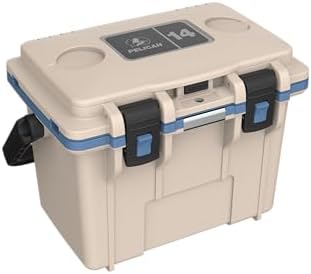
If you want a rotomolded cooler that holds ice longer than a Yeti and costs less, get the Pelican 14 Quart Elite. It's the best value in this category, and it's tough enough for a decade of abuse. If you need the brand name or the lifetime warranty, get the Yeti Roadie. Just know you're paying for peace of mind, not performance.
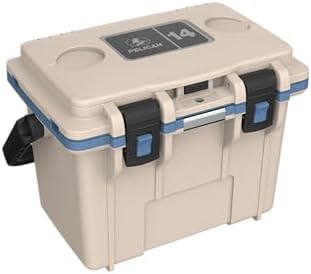
One more thing: there are a couple of other 14-quart options floating around on Amazon. The Pelican 14 Quart is a standard version, not a newer version of the Elite. I haven't tested it yet, but the specs are identical. And the 14 Quart is a third variant that appears to be the same mold with a different color. I'd stick with the Elite if you want the best ice retention.
What I'm testing next
I've got a Pelican 20 Quart Elite on order, and I'm going to run it against the Yeti Tundra 35 in the same 4-day test. The bigger sizes are where the price gap gets even wider, and I want to see if Pelican holds the same advantage. Check back in a few weeks.