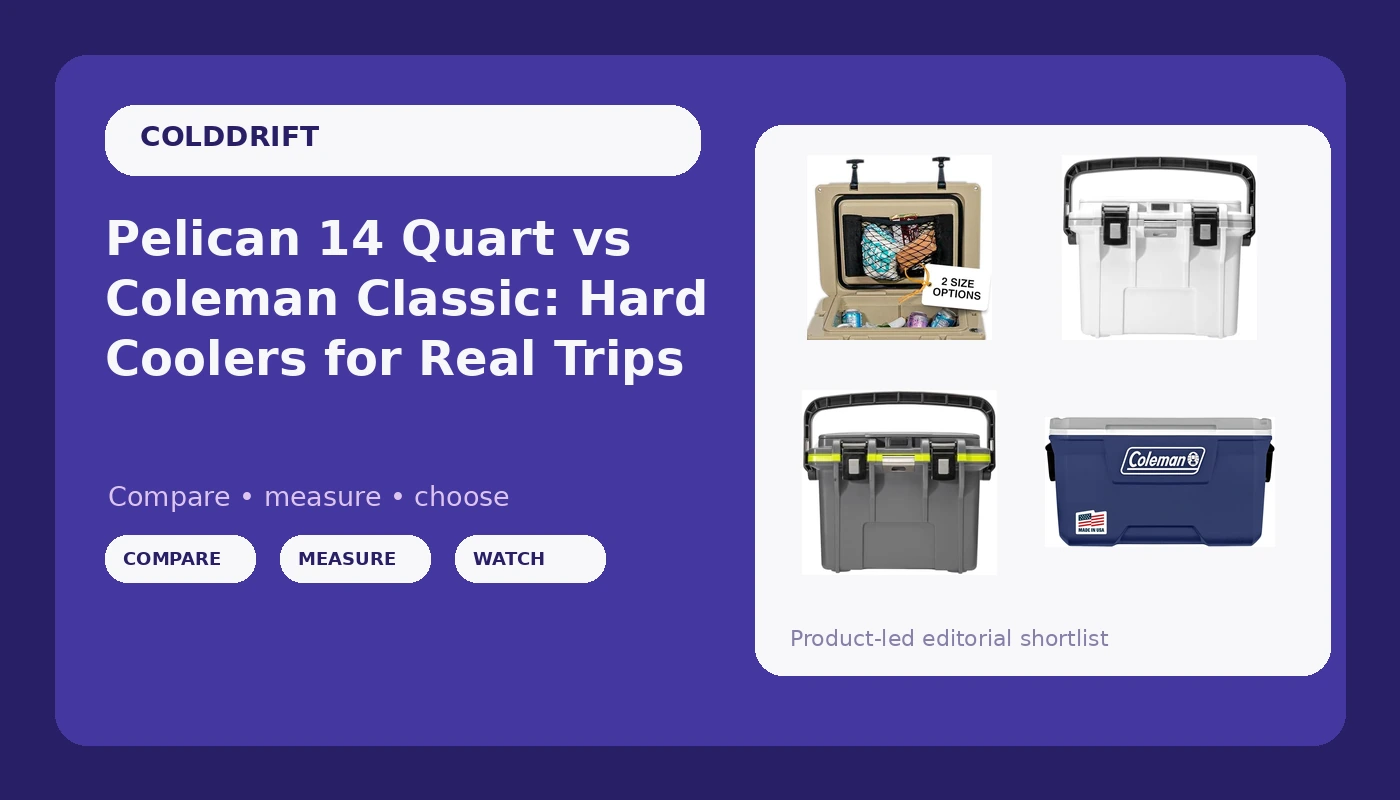
I've guided on Lake Superior for 15 years, and I've watched more walleye, more bait, and more potato salad go warm than I'd like to admit. When I compare hard coolers for fishing trips, I'm not grading cupholders or colorways. I'm grading the gasket, the latches, the drain plug, and how much ice is still in the box after a long weekend in the sun. This comparison covers four listings: two entries for the same Pelican 14 Quart Cooler, the Coleman Classic Series Insulated Portable Cooler in its 52, 70, 120, and 150 quart sizes, and a Cooler Net for Dry Storage and Organization that fixes the one problem every hard cooler has.
The short answer: the Pelican 14 Quart Cooler is the box I'd carry onto a boat, and the Coleman Classic Series is the one I'd buy for a tailgate, a cabin week, or a crowd. If you already own either, the cooler net is the smallest useful upgrade in this group.
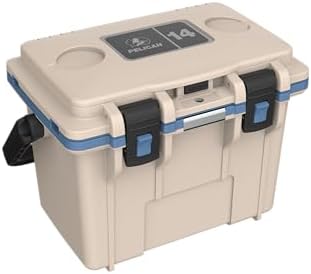
Pelican 14 Quart Cooler
The brand I trust most on a boat deck, small enough to carry loaded, built for abuse
14 quarts is a day-trip box, not a weekend box
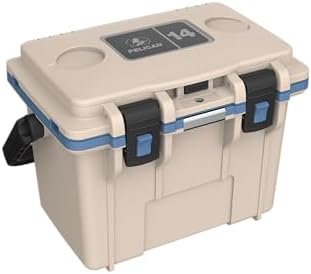
Pelican 14 Quart Cooler
The same cooler under a second listing, so you have a better shot at finding one in stock
Read it as one product, not two, because the hardware is identical
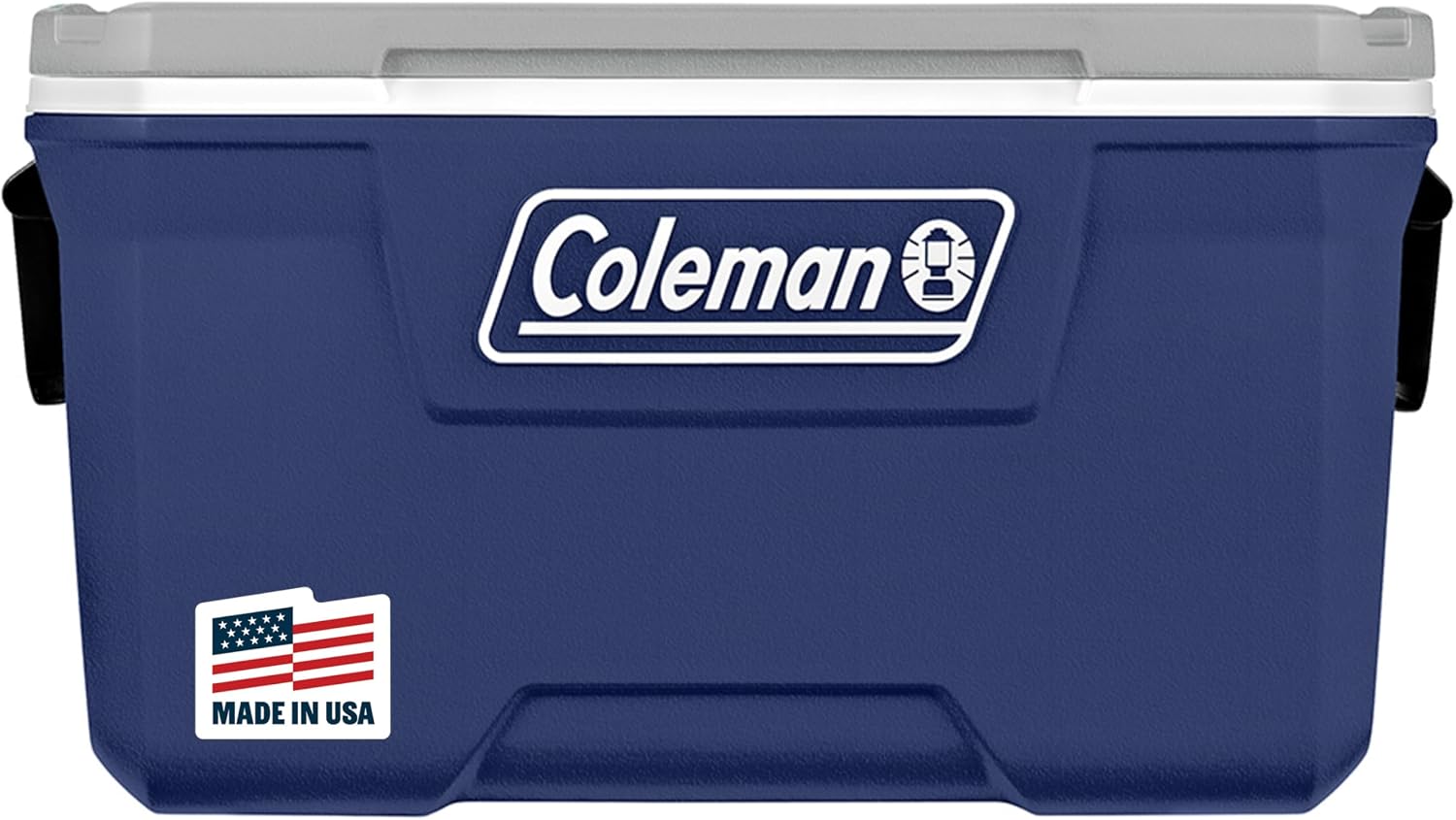
Coleman Classic Series Insulated Portable Cooler
Four sizes in one listing, leak-resistant, the volume play when you're feeding a crowd
Coleman's "up to 5 days" ice claim is the most optimistic line in this article
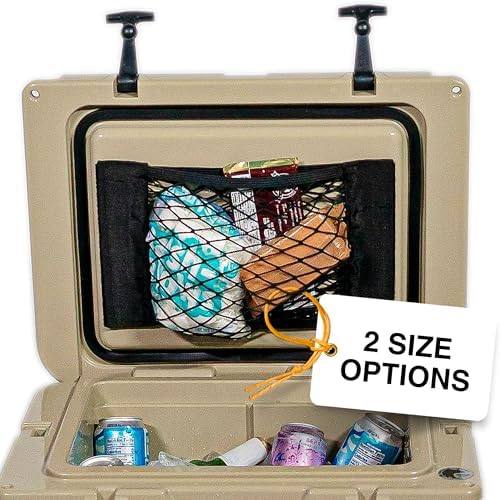
Cooler Net for Dry Storage and Organization
Turns wasted cooler space into dry storage, fits most major brands
It holds zero ice, so it's an add-on, not a cooler
Prices and availability were captured from Amazon Creators API and may change.
How I judge a cooler before it earns deck space
My routine doesn't change. Twenty pounds of ice, a box full of real food, and a temperature log that starts at 6 AM Thursday and ends Sunday afternoon. I open the lid the way a real trip opens it, which is constantly. I check the gasket by closing the lid on a strip of paper and pulling: if the paper slides out with no drag, the seal is already lying to you. I check the latches on a washboard road. I check the drain plug before the trip, not during it. Then I lift the thing when it's full, because a cooler you can't lift is a dock ornament.
That routine is why I don't rank coolers by cupholders or by the number of stickers on the lid. Ice retention is the only spec that matters. Everything else is a handle and a hinge.
Pelican 14 Quart Cooler: the two listings are one cooler
Two of the four entries here carry the same name. That's not a mistake in this table and it's not two different products. It's the same 14 quart box listed twice, which usually means two colorways or two sellers. Treat them as one recommendation and buy whichever listing is in stock when you're shopping.
What you're buying is the Pelican reputation. In my experience on the water, Pelican is the brand that survives a boat deck. I've watched Pelican boxes get kicked, rained on, sat on, and dropped, and keep sealing. That matters more than a molded ruler on the lid or a drain plug with a fancy handle.
What you're not buying is volume. Fourteen quarts is a day-trip box: lunch, drinks, a couple of fish, and a bag of ice. That's it. If you're packing for a three-day trip for two people, this is your bait and lunch cooler, not your main food cooler. Buy it for what it is and it will earn its space on the boat. Buy it expecting a weekend of ice for a family and you'll be disappointed, and you'll blame the cooler instead of the size you chose.
Here's the other thing about a 14 quart hard cooler: it's the size you can carry with one hand, full, from the truck to the dock to the kayak without a second trip. That sounds like a small thing until you've done the two-trip shuffle with a 70 quart box at 5 AM.
Visit on Amazon → for the first listing, or Visit on Amazon → for the second.
Coleman Classic Series: the volume play
Coleman sells this one in 52, 70, 120, and 150 quart sizes under a single listing, which is why the name reads like a menu. The construction is what you'd expect at this tier: insulated, leak-resistant, hard-sided, and built to be affordable rather than indestructible. It is not a rotomolded box and it doesn't pretend to be one.
The claim on the packaging is that it keeps ice up to 5 days. I'll be blunt: that number assumes a full cooler, shade, a closed lid, and a mild day. My experience with budget hard coolers is that the multi-day claim is optimistic, and a hot, sunny, constantly opened box will burn through ice faster than the marketing suggests. That said, this is the cooler I'd hand a tailgater or a family headed to a rented cabin, because it does the job that most people actually need done, and it does it without a premium-tier commitment.
Sizes matter more than the brand here. The 52 and 70 quart boxes are realistic for a couple or a small family on a weekend. The 120 and 150 quart boxes are party coolers, and they get heavy when they're full. Do the lift test in your head before you buy: a 150 quart box loaded with ice, drinks, and a watermelon is a two-person job, and it stays a two-person job all weekend. I've watched people buy the biggest box on the shelf and then leave it in the truck because nobody wants to move it.
The other honest note: this is the cooler that benefits most from good habits. Pre-chill it with a bag of ice the night before. Keep it out of direct sun. Drain the meltwater instead of letting it float your food. Do those three things and the gap between this box and a premium box narrows more than the price gap suggests.
The cooler net: the small fix for a real problem
Every hard cooler has the same flaw. Dry stuff and wet stuff compete for the same space. Bread, a phone, keys, a towel, and a bag of chips end up sitting on melting ice or in a puddle at the bottom, and by Saturday everything smells like lake water.
The Cooler Net for Dry Storage and Organization solves that by strapping dry storage to the outside of the cooler. It's compatible with YETI, RTIC, Ninja, Igloo, Coleman, Lifetime, and Pelican ice chests, and the listing also mentions cooler lights, wheel kits, and other RTIC accessories, so it plays nicely with the gear you've already bolted on.
What it won't do is keep anything cold. It's not insulation, it's not a lid, and it won't rescue a cooler with a warped gasket. It's an organizer, and as organizers go, it's a genuinely useful one. If you already own a cooler from this comparison, this is the add-on that changes how the box works on a trip. If you don't own a cooler yet, buy the box first and come back for this.
Size honesty, which nobody does in the store
The most common cooler mistake isn't brand, it isn't construction, and it isn't the gasket. It's size. People buy the box that fits the trip they're imagining, not the trip they take.
If you fish alone or with one other person and you're out for a day, the Pelican 14 Quart Cooler is the right call. If you're feeding four to eight people at a tailgate or a cabin, the Coleman Classic Series in a 52 or 70 quart size is the right call. If you're feeding a party and you have help carrying it, the 120 and 150 quart sizes exist for exactly that.
The test I use: fill the cooler you're considering with the drinks and ice you'd actually bring, then carry it from your truck to your front door. If you can't do that comfortably, you bought too much cooler. A box that lives in the truck bed because it's too heavy to move isn't keeping anything cold.
What the trade-offs actually look like
There's a real split in this group, and it isn't quality versus junk. It's abuse tolerance versus volume.
The Pelican 14 Quart Cooler wins on abuse tolerance and portability. It loses on capacity, and it loses on the "one cooler for everything" job. It's a specialist.
The Coleman Classic Series wins on volume and flexibility, because one listing covers four sizes and the largest sizes will hold food for a crowd. It loses on long-term durability and on the optimism of its ice claim. It's a generalist.
The cooler net doesn't compete with either. It's a $20-class accessory in spirit, an organizer that makes whatever box you own work better. In a comparison of coolers it looks like the odd one out, and that's fair, but it's also the item in this group that most people will use every single trip.
Who each one is for
- Kayak and boat anglers, day trips: Pelican 14 Quart Cooler. One hand, one trip, real seals.
- Families and tailgaters, weekend volume: Coleman Classic Series in 52 or 70 quarts. Pre-chill it, shade it, drain it.
- Party hosts with a truck and a helper: Coleman Classic Series in 120 or 150 quarts, with the lift test done honestly first.
- Anyone who already owns a hard cooler: the Cooler Net for Dry Storage and Organization, because dry storage on the outside beats soggy bread on the inside.
Questions I get on the dock
Is the Pelican 14 Quart Cooler worth it over a budget box? If you fish, camp, or tailgate more than about ten days a year, yes. Abuse tolerance is the thing budget boxes can't fake, and a box that seals after five seasons is cheaper than three boxes that don't.
Does the Coleman Classic Series really hold ice for five days? Treat that as a best-case number, not a promise. Full box, shade, closed lid, mild weather. In real sun with real opening, expect less.
Do I need the cooler net? Need, no. Want, probably. It's the difference between digging for your keys in meltwater and grabbing them off the side of the box.
The bottom line
Buy the Pelican 14 Quart Cooler if your trips are short, wet, and hard on gear. Buy the Coleman Classic Series if your trips are long, crowded, and need volume more than bulletproof construction. Buy the cooler net if you already own a hard cooler and you're tired of wet bread.
That's the whole decision, and none of it requires a cupholder.
Visit on Amazon → for the Pelican 14 Quart Cooler, Visit on Amazon → for the Coleman Classic Series, and Visit on Amazon → for the cooler net.