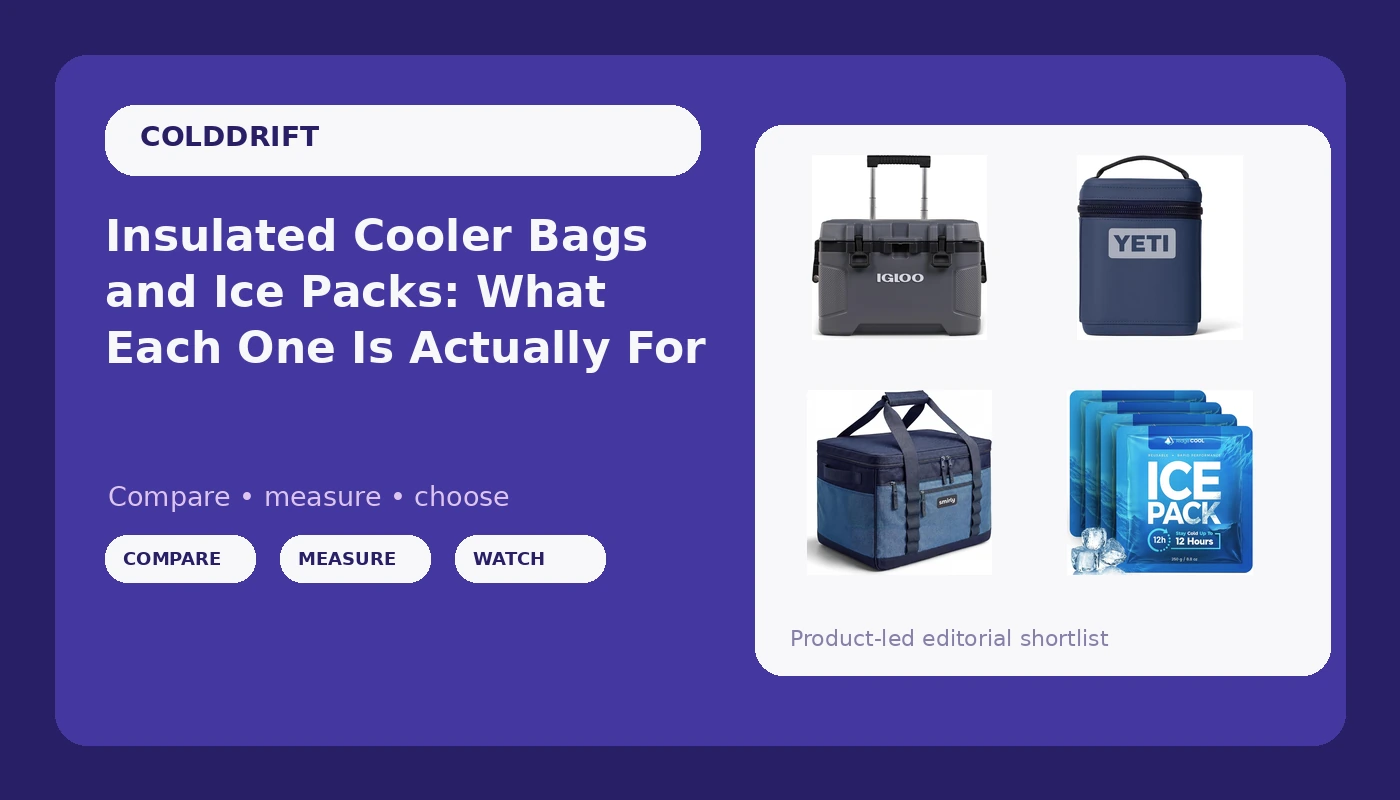
The cold problem on a camping or fishing trip is almost never one problem. It is a packing problem, a space problem, and a heat problem at the same time, which is why insulated cooler bags and ice packs so often end up in the same cart as a wheeled cooler and then get used badly. A roller that stays in the truck bed, a soft bag that rides in the canoe, and a set of reusable freezer packs that moves between both are three different tools answering three different questions. This guide walks through what each of the four options below is built to do, where each one stops being useful, and how to decide which combination fits the way you actually travel. Nothing here leans on a marketing claim about ice life. It leans on matching the gear to the trip.
Related: How to Test a Cooler Drain Plug Before a Trip →
Quick answer
The short version: a wheeled hard cooler is for base camp and heavy loads, soft-sided bags are for carrying food to where you are, and reusable ice packs are the cold source you swap in when you do not want meltwater sloshing around the bottom of a bag. Buy each one for the job it is shaped for instead of expecting a single container to do all three.
Four useful options
| Model | Best fit | What stands out |
|---|---|---|
| Igloo Trailmate 52 Qt Roller Cooler, Carbonite | Base camp, truck bed, shoreline | 52-quart stated capacity in a wheeled roller format |
| YETI Daytrip 2L Insulated Soft Cooler Snack Box, Classic Navy | Short outings and snack duty | 2-liter insulated soft-sided snack box format |
| SMIRLY Cooler Bags Insulated, Large Soft Collapsible Cooler, 48 Cans | Hauling volume, storing flat | Collapsible soft-sided body sized for up to 48 cans |
| Ice Packs for Cooler, Reusable Ice Packs for Lunch Boxes, 4 Pack Long Lasting Freezer Packs, Leakproof Cooler Ice Packs for Lunch Bags and Coolers, BPA-Free, Food Safe | Replacing loose ice in bags and small coolers | Four reusable, leakproof, BPA-free freezer packs |
The base camp: Igloo Trailmate 52 Qt Roller Cooler, Carbonite
A cooler in this size class is a base camp tool. It sits in one place for the day and gets opened a few times, which is exactly the pattern that protects ice, because every lid opening dumps cold air and lets warm air settle in. The trade-off is weight. A 52-quart body plus ice plus a day of food and drinks is a load you feel when you lift it into a truck bed or a boat, and wheels do nothing for that part. The other trade-off is footprint: this is not a container that lives in a canoe or gets carried a half mile down a trail. Whatever hard-sided cooler you run, check the drain plug and the gasket at home, in the driveway, before the trip. Both fail quietly, and both fail at the worst possible moment.
The snack box: YETI Daytrip 2L Insulated Soft Cooler Snack Box, Classic Navy
This is the container people misjudge most often. A 2-liter snack box is not a trip cooler and was never meant to be one. It is the bag that keeps a sandwich, a couple of drinks, and a piece of fruit cold between breakfast and lunch, or that holds the cheese and butter while the big cooler stays shut. The practical value is in the separation: opening a small insulated box costs you almost nothing in cold air, while opening the main cooler every time somebody wants a drink costs you a little ice every single time. If you carry one of these, treat it as the decoy. Put the things people reach for constantly inside it, and leave the big container closed.
The collapsible hauler: SMIRLY Cooler Bags Insulated, Large Soft Collapsible Cooler, 48 Cans
Soft-sided bags win on two things a hard cooler cannot match: they conform to the space you have, and they store flat in a closet or a gear bin when the season ends. They lose on two others. First, soft walls insulate less efficiently than thick molded walls, so the cold budget is shorter and depends more on what you put inside. Second, a soft bag with loose ice becomes a wet bag, because meltwater has nowhere to go. That is the single strongest argument for pairing a bag like this with sealed freezer packs rather than cubed ice. If you do use loose ice in a soft bag, use a liner and plan on the bottom being wet by afternoon.
The cold source: Ice Packs for Cooler, Reusable Ice Packs, 4 Pack
Freezer packs are the least glamorous item in this list and the one that changes the most trips. The case for them is simple: they hold cold without turning into a puddle, they can be stacked flat against the walls of a bag, and they can be re-frozen and reused all season. The case against them is that they take up space that ice would otherwise occupy, and they need to be genuinely frozen solid before they go in, not cold from the fridge. A pack that has been sitting in a refrigerator for an hour is a pack that will pull heat out of your food instead of holding it back. Four packs is a workable number for a small bag or a snack box: two against the bottom, two against the top, food in the middle.
Prices and availability may change. Product images, names, and retailer links are matched to verified product records. Do not state a current price, rating, stock status, or measured result without current evidence.
What actually keeps a cooler cold
Almost everything that determines how long food stays safe comes down to three things, and none of them is the sticker on the lid.
The first is insulation. Molded, thick-walled bodies hold cold longer than thin soft-sided walls, which is the entire reason a rotomolded or heavy hard cooler costs what it costs. Thicker walls mean a slower heat transfer from the outside air to the inside contents. Soft bags compensate by being smaller, lighter, and easier to keep out of the sun, but the physics do not change.
The second is the seal. The gasket around a lid, or the zipper on a soft bag, is what stops cold air from spilling out and warm air from sliding in. A gasket that is warped, pinched, or coated in dried food debris is a container that is quietly leaking cold all day. Run a finger around the seal before every trip. If the lid does not resist slightly when you close it, something is wrong.
The third is the ratio of cold mass to empty air. A cooler that is half full of air is a cooler that spends its stored cold cooling that air, over and over, every time the lid opens. Fill the voids. Frozen water bottles, extra freezer packs, a rolled towel, or simply more food all reduce the air space and extend the useful window.
Two smaller factors matter as much as people expect them to. Pre-chilling helps: a cooler loaded with room-temperature drinks starts the day already behind, so chill everything in the fridge first, or add a sacrificial bag of ice the night before and dump the meltwater in the morning. And access frequency is the silent killer. Every opening trades cold air for warm air. Consolidating drinks and snacks into a small insulated box is one of the cheapest performance upgrades available, because it keeps the main lid shut.
How to size and pack for a trip
- Count what you are actually chilling. Meals, drinks, and anything that has to stay cold for safety, separately. That list, not the trip length, is what sets your capacity.
- Choose the format before the size. Base camp with a truck nearby points to a wheeled hard cooler. A walk, a paddle, or a climb points to a soft bag. A lunch window points to a snack box.
- Pre-chill the container and the contents. A cold cooler holds cold longer than a warm one, and the same is true of every item inside it.
- Fill the empty space. Stack sealed freezer packs against the walls and lid, and put food in the middle. Air is the enemy, and freezer packs are the cheapest way to displace it.
- Test the seal, the latches, and the drain at home. Close the lid on a strip of paper and pull. Fill it, drain it, and check for drips in the driveway. Do this before the trip, never during it.
Practical guidance that pays off
- Keep soft bags and snack boxes out of direct sun and off hot surfaces. A bag sitting on a black truck bed liner is being heated from below all afternoon.
- Freeze the packs flat and stack them in the freezer so they go into the bag as slabs. Flat packs line walls and lids efficiently, and they freeze faster than a pile of loose ones.
- Run two containers instead of one oversized one. Drinks in one, food in the other. Drinks get opened constantly; food does not, and separating them protects the food.
- Bag anything that can leak, and keep raw meat in its own sealed container at the bottom. Meltwater moves, and it does not respect packaging.
- Load the heavy wheeled cooler first and low, and strap or wedge it so it cannot slide. A cooler that shifts on a rough road takes latches and gaskets with it.
- Keep a spare freezer pack frozen at home and swap it in at the trailhead or the boat ramp. A mid-trip swap costs nothing and buys hours.
Which option should you choose?
Choose the Igloo Trailmate 52 Qt Roller Cooler, Carbonite when the cooler stays near the vehicle, the boat, or the campsite and you need real capacity without carrying it. Choose the YETI Daytrip 2L Insulated Soft Cooler Snack Box, Classic Navy when you need a small insulated box for lunch, snacks, or the items people reach for constantly, so the main cooler can stay closed. Choose the SMIRLY Cooler Bags Insulated, Large Soft Collapsible Cooler, 48 Cans when you need to move a lot of food and drink by hand, or when storage space at home is the limiting factor. Choose the Ice Packs for Cooler, Reusable Ice Packs, 4 Pack when you want cold without meltwater in a bag, a lunch box, or a small cooler.
One caveat worth stating plainly. Capacity figures and material claims here come from the product names and listings, and real performance depends on fill level, outside temperature, how often the lid opens, and whether everything went in cold. Check the current listing for dimensions, materials, and construction details before you commit, because those are the numbers that decide whether a container fits your trunk, your pack, or your canoe.
The bottom line
There is no single container that covers a fishing weekend, a tailgate, and a Tuesday lunch, and shopping as if there is one is how people end up with a cooler that is always either too big to carry or too small to matter. The workable setup is a division of labor: a wheeled hard cooler for the bulk that stays put, a soft-sided bag or snack box for what travels, and reusable freezer packs to supply the cold without supplying the puddle. Get the seal and the fill level right, pre-chill everything, keep the lid shut, and the gear stops being the weak point in the trip.