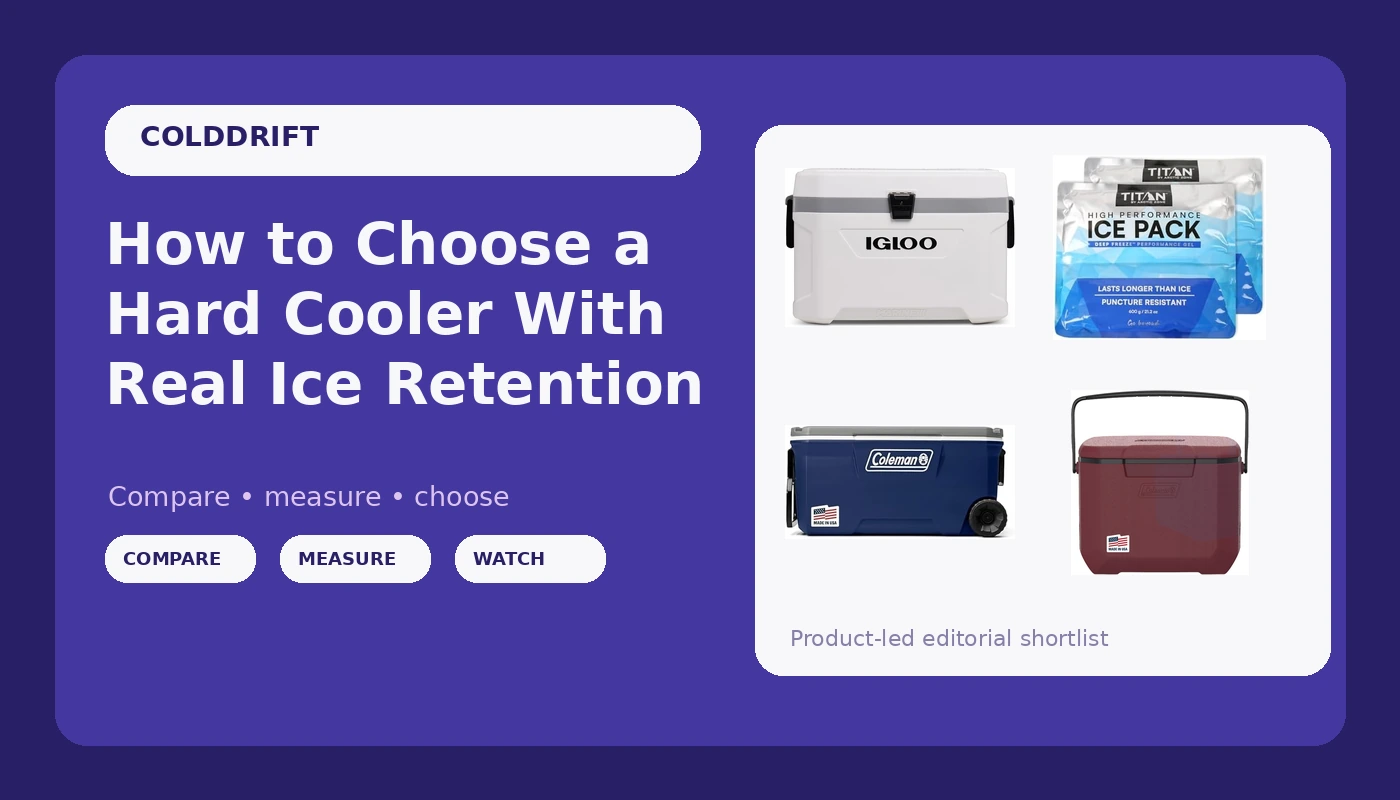
Buying a hard cooler looks simple until you are standing in the aisle. Ice retention numbers get printed in giant type on the lid, sizes get listed like a restaurant menu, and the words leak resistant show up on nearly every box in the row. None of that tells you whether your ice will still be there on Sunday afternoon. Cooler ice retention comes down to two unglamorous things: how well the box is insulated, and how cleanly the lid gasket seals against the rim. Everything else, the handles, the hinges, the color, is decoration until the seal fails.
This explainer covers four products that solve four different problems: a marine cooler for boat and dock days, a wheeled hard cooler for hauling, a size-range cooler for mixed weekend duty, and a reusable ice pack that backs up whichever box you already own. No invented test numbers, no prices frozen in time, just the fit and the trade-offs.
Related: How to Pack a Cooler So the Ice Lasts All Weekend →
Quick answer
Match the cooler to how long you will be out and how far you have to carry it. For boat and dock days, the Igloo Marine Cooler is an insulated hard shell ice chest positioned by the maker for fishing, camping, and boating. For the long walk from the truck to the tailgate, the Coleman Classic Series Insulated Portable Rolling Cooler puts wheels under the load. For one box that covers a range of trips, the Coleman Chiller line is offered in sizes from 9qt up to 60qt. And a two-pack of Arctic Zone Titan Deep Freeze Ice Packs is the inexpensive insurance that keeps food cold while you sort out the bigger decision. None of these is being crowned here as the strongest, toughest, or safest cooler on the market. The useful distinction is which job each one is built for.
Four useful options
| Model | Best fit | What stands out |
|---|---|---|
| Igloo Marine Cooler | Fishing, boating, dock days | Insulated hard shell chest that the maker builds and markets specifically as a marine cooler |
| Coleman Classic Series Insulated Portable Rolling Cooler | Long carries, tailgates | Wheeled hard cooler that Coleman describes as leak resistant with ice retention up to 5 days |
| Coleman Chiller | One cooler for mixed weekend duty | Sold in several sizes, from 9qt through 60qt, with ice retention and leak resistance as the stated design goals |
| Arctic Zone Titan Deep Freeze Ice Pack (2 Pack) | Backing up any hard cooler | Two reusable packs that replace bagged ice and pre-chill an empty box |
The marine pick: Igloo Marine Cooler
Marine coolers exist because a boat deck is a hostile place for a box. It gets sun on one side, spray on the other, and it gets kicked. A hard shell chest like this one is the format that survives that, and Igloo builds this model around the assumption that it lives on a boat rather than in a trunk. That focus is also the trade-off. A chest built for the deck is not the cooler you want to carry a half mile to a picnic table, and it is not the one you buy for a concert parking lot. If your trips are measured in hours on the water rather than yards on pavement, this is the shape of box that matches the job. Before any trip, run a finger around the lid gasket and check that it sits flat and springs back. A gasket that has gone stiff or warped is a cooler that will lie to you about how much ice you have left.
The rolling pick: Coleman Classic Series Insulated Portable Rolling Cooler with Wheels
Wheels are the single most underrated feature on a hard cooler, because the honest limit on cooler size is not space, it is your back. A full box of ice, drinks, and food gets heavy fast, and a wheeled cooler moves that weight to the pavement instead of your shoulder. Two caveats worth knowing before you buy. First, the up to 5 days figure is a manufacturer claim, and ice retention claims assume a closed lid and a reasonable starting temperature. Pre-chill the box, fill it near the top, and keep the lid shut, and you give that number a chance. Open it every twenty minutes at a tailgate and you will not see day five. Second, wheels roll well on pavement, boardwalks, and packed gravel. On soft sand they dig in. If your access is sand, plan on carrying.
The size-range pick: Coleman Chiller
A size range matters more than most buyers expect, because the wrong size is the most common cooler mistake. Buy too small and you are rationing ice and stacking warm drinks on top of cold ones. Buy too large and you end up with a box that is a permanent dock ornament because nobody wants to lift it when it is loaded. The Chiller line covers the middle of that range, from a small 9qt box for a lunch run up to a 60qt chest for a full weekend of camping. The 30qt and 48qt sizes are where most households land. A practical rule: choose the size by picturing it full of ice and food, then asking whether you can carry it from the car to the campsite without setting it down twice. If the answer is no, either step down a size or step up to something with wheels.
Prices and availability may change. Product images, names, and retailer links must be matched by verified ASIN. Do not state a current price, rating, stock status, or measured result without current evidence.
The cold source: Arctic Zone Titan Deep Freeze Ice Pack (2 Pack)
Reusable packs do two jobs that bagged ice cannot. First, they pre-chill an empty cooler before the food goes in, which is the difference between starting at room temperature and starting cold. Second, they hold cold without turning into a puddle, so the bottom of the box is not a soup of melted ice and floating lunch meat. The trade-off is volume. Every pack you drop in is space that ice or food could have used, and a two pack will not carry a 60qt chest through a weekend on its own. Treat it as support for your ice, not a replacement for it. If you already own a hard cooler that is doing a decent job, adding a pair of reusable packs is a smaller, cheaper move than buying a new box.
What ice retention actually means
Ice retention is the number of days a cooler keeps ice under real use, and the gap between that and a lab number is where most buyers get burned. Manufacturer retention ratings are usually established under controlled conditions: a closed lid, a moderate ambient temperature, and often a stated ice-to-contents ratio. Your trip is not that. You open the lid for a beer, you leave the box in direct sun on a black boat deck, you started with a warm box and five pounds of ice. Each of those moves eats into the rating.
The three variables you actually control are starting temperature, fill level, and how often the lid comes up. A cooler that starts cold holds dramatically longer than one that starts at seventy degrees. A cooler packed nearly full holds longer than one that is half empty, because air is a poor thermal mass and every empty inch is a space your ice has to cool down. And every lid opening dumps the cold air sitting at the top and replaces it with warm outside air. Coolers do not fail on a curve. They fail in a hurry once the ice volume drops below the point where it can keep the interior cold, which is why a box that looks fine on Saturday morning can be a warm bathtub by Saturday night.
That also explains why the size question is really a duration question. If you need three days, you need enough ice to survive three days of openings, which means a bigger box than a day trip requires. If you need six hours, a small box with a reusable pack and a tight lid is plenty.
Gaskets, latches, hinges, and drain plugs
The lid gasket is the whole game. It is a rubber seal that sits in the lid channel and presses against the rim when the lid closes, and when it is doing its job, the lid should resist you slightly on the way up. A gasket that has gone hard, cracked, or warped lets cold air leak out continuously, and no amount of extra ice fixes a box that leaks. Check it by hand before every season. Look for flat spots, kinks, and places where the rubber has pulled away from the channel.
Latches are the second failure point, and the failure mode is subtle. A latch that pops open on a rough road does not announce itself. You find out at the campsite when the lid has been cracked for two hours. Rubber straps tend to hold better than stiff plastic clips under vibration, but the real test is whether the latch holds the lid down tight when the cooler is full and the lid is slightly bowed. Push down on the closed lid and watch the latch.
Drain plugs are a feature until they leak, and they leak at the worst possible time, which is after the ice has melted and the water is now on your trunk carpet. Test yours at home with a couple inches of water before the trip, not during it. And hinges, which nobody thinks about until they crack, should be checked for stress marks at the screw points.
Before you buy any cooler, run this five step check:
- Count the days you will actually be out, not the hours, and add a day of margin for heat and delays.
- Measure the space the box has to live in, whether that is a trunk, a dock box, or a boat deck locker.
- Lift the empty cooler and imagine it full of ice, drinks, and food, then decide honestly whether you can carry it.
- Open and close the lid and feel the gasket, then push down on the latched lid to check for play.
- Decide whether you need wheels for the distance you will haul it, and whether you want a backup cold source in the box.
Packing and pre-trip habits that protect the rating
- Pre-chill the cooler with a bag of ice or a reusable pack the night before, and dump the meltwater before loading.
- Pack the box as full as you reasonably can. Empty air is the enemy of ice retention.
- Keep the cooler out of direct sun and off hot surfaces, and put a blanket or towel over the lid if it has to sit outside.
- Group drinks in a separate small cooler so the main box is not opened every twenty minutes.
- Test the drain plug and inspect the gasket before every trip, not after the first leak.
Which option should you choose?
Choose the Igloo Marine Cooler when the box lives on a boat or a dock and the trips are fishing trips rather than parking lot parties. Choose the Coleman Classic Series Insulated Portable Rolling Cooler with Wheels when the haul is long, the load is heavy, and pavement or packed gravel is the surface underfoot. Choose the Coleman Chiller when you want one cooler design that scales across several trip sizes, and you want to pick the exact volume rather than settle for whatever is on the shelf. Choose the Arctic Zone Titan Deep Freeze Ice Pack (2 Pack) when you already own a hard cooler that works and you want a cheaper way to give it a head start.
The caveat on all four is the same. Ice retention figures are manufacturer claims made under controlled conditions, and none of them have been independently verified here against a temperature log. Treat a stated number as an upper bound, not a promise, and judge your own box by what is left in it on the last morning of a real trip.
The bottom line
Cooler ice retention is not a sticker, a color, or a cupholder. It is insulation, a sealed lid, and the discipline to keep the box cold, full, and closed. Buy the format that matches your trip: the Igloo Marine Cooler for boat and dock duty, the Coleman Classic Series Insulated Portable Rolling Cooler with Wheels when your back needs the help, the Coleman Chiller when you need to dial in a specific size, and the Arctic Zone Titan Deep Freeze Ice Pack two pack when you want to squeeze more cold out of the cooler you already have. Then test the gasket and the drain plug before the trip, because that is the part you control.