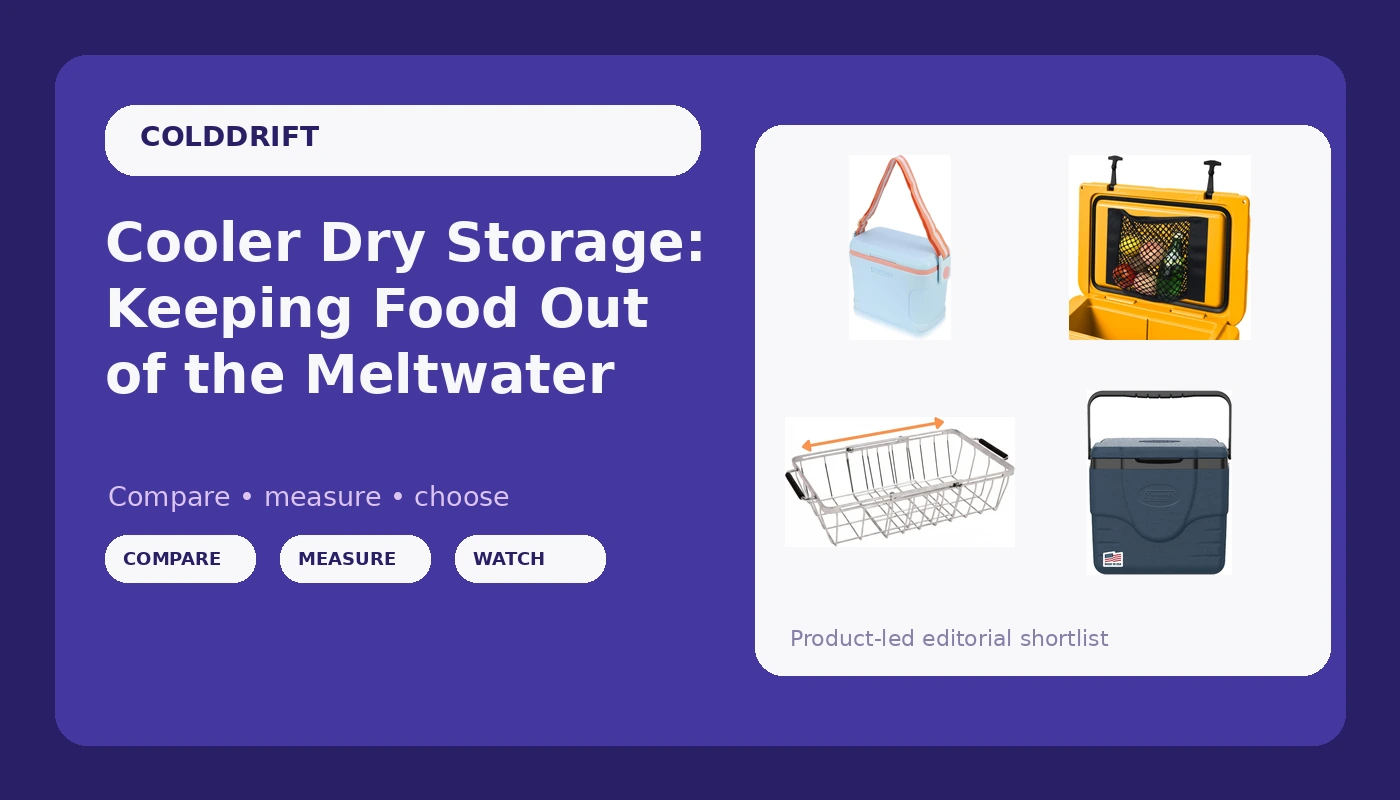
Cooler dry storage accessories are the cheapest upgrade in the entire cooler aisle, and they fix the problem that ruins more trips than warm drinks: food sitting in meltwater. A cooler does two jobs at once, holding ice and holding food, and those two jobs fight each other. Ice melts, water collects in the bottom, and anything touching that water gets soggy while it also warms faster than the air around it. The fix is not a bigger cooler or another bag of ice. It is a way to lift dry goods above the water line, plus a second, smaller cooler for the things you open the lid for twenty times a day.
Related: How to Pack a Cooler for a Three-Day Trip →
Quick answer
Dry storage works when you separate three jobs: a full-size hard-sided chest for the bulk of the ice and the food you will not touch until dinner, a small cooler for the items you reach for all day, and an insert that holds dry goods above the meltwater. A stretch net and an adjustable rigid basket are the two insert styles that fit most full-size chests. Buy the insert first, then size the cooler around the trip you actually take.
Four useful options
| Model | Best fit | What stands out |
|---|---|---|
| Coleman Chiller 9/16/30/48/60qt Cooler with Ice Retention, Leak Resistant, Great for Camping, Concerts, Sports, and More | The main ice chest | Listed in five capacities from 9 to 60 quarts, with ice retention and leak-resistant construction described in the listing |
| Pinnacle 8.5Qt Mini Cooler, 14 x 7.6 x 10.6In Ice Box with Smart Divider, Locking Lid, Adjustable Shoulder Strap, Insulated Picnic Basket Beach Cooler Bag, 36- Hour Ice Retention, Stylish Colors | The all-day grab cooler | 8.5-quart soft-sided bag with a smart divider, locking lid, and shoulder strap, listed at 36-hour ice retention |
| 2PCS Cooler Net for Dry Storage, Fits Most Coolers, Compatible with Yeti, Coleman, Igloo, Lifetime, Pelican, Canyon, Strong & Elastic | The light dry goods net | Two elastic nets the listing says fit most coolers and several major brands |
| Adjustable Cooler Basket - Expands 11.75" to 18.5" - Non-Slip Rubber Handles, Universal Insert for Full Size Ice Chests, Dry Goods Tray Cooler Accessory - Fits Igloo, Coleman, Lifetime, Pelican, More | The rigid dry goods tray | Expands from 11.75 to 18.5 inches, with non-slip rubber handles and universal fit for full-size ice chests |
The base cooler: Coleman Chiller 9/16/30/48/60qt Cooler with Ice Retention, Leak Resistant, Great for Camping, Concerts, Sports, and More
The capacity range is the real feature here, and it is also the trap. A 60-quart chest holds a weekend of food and ice, and it is also the cooler that stays in the truck because nobody wants to carry it loaded. A 30-quart is the size most couples and small families can still lift onto a tailgate by themselves. Buy the size you can move when it is full, because a cooler that never leaves the vehicle is a cooler that never gets used. Whatever you pick, the drain plug and the lid gasket are the two parts worth checking before a trip rather than during one.
The all-day cooler: Pinnacle 8.5Qt Mini Cooler, 14 x 7.6 x 10.6In Ice Box with Smart Divider, Locking Lid, Adjustable Shoulder Strap, Insulated Picnic Basket Beach Cooler Bag, 36- Hour Ice Retention, Stylish Colors
The point of a second, small cooler is not extra capacity. It is lid discipline. Every time someone opens the big chest for a soda, cold air pours out and warm air pours in, and by Saturday afternoon the ice is a memory. A soft-sided bag you can sling over a shoulder keeps drinks and snacks out of the main chest entirely. The trade-off is honest: soft-sided coolers do not hold ice the way a hard chest does, and a 36-hour listing figure assumes it stays shut in the shade. Treat the number as a claim from the maker, not a promise about your tailgate.
The light net: 2PCS Cooler Net for Dry Storage, Fits Most Coolers, Compatible with Yeti, Coleman, Igloo, Lifetime, Pelican, Canyon, Strong & Elastic
A stretch net is the lightest answer to the soggy-sandwich problem. It holds bread, tortillas, fruit, and snack bars up against the underside of the lid, above the water line, and it weighs almost nothing. The limits are obvious once you think about them: an elastic net is not a shelf, and heavy cans or a full water bottle will drag it down and stretch it out. Keep it for light, sealed items, and remember that "fits most coolers" still depends on whether your lid has a rim or lip the net can hook over.
The rigid tray: Adjustable Cooler Basket - Expands 11.75" to 18.5" - Non-Slip Rubber Handles, Universal Insert for Full Size Ice Chests, Dry Goods Tray Cooler Accessory - Fits Igloo, Coleman, Lifetime, Pelican, More
A rigid basket does what the net cannot: it carries weight. Lunch meat, a carton of eggs, a bag of grapes, a loaf of bread that you do not want crushed, all of it rides above the ice instead of sinking into it. Because the width is adjustable across a stated range, it fits a wider spread of chests than a fixed tray, but "universal" still has edges. Measure the inside of your cooler at the rim and again near the bottom before you buy, since many chests taper toward the base and a tray that fits at the top can drop through in the middle.
Prices and availability may change. Product images, names, and retailer links must be matched by verified ASIN. Do not state a current price, rating, stock status, or measured result without current evidence.
Why water, not warm air, is what ruins your food
Ice does not keep food cold by making the cooler chilly. It keeps food cold by absorbing heat, and it does that best while it is still solid. Once meltwater pools in the bottom, two things happen at once. First, the water sits against the remaining ice and melts it faster from the outside in, so your ice life shortens. Second, anything resting in that water gets the heat pulled out of it quickly, which is why a sandwich in the puddle is both soggy and oddly cold, and why bread and paper wrappers fall apart first.
That is the entire argument for dry storage. Lifting food off the floor of the chest keeps it out of the puddle, keeps packaging intact, and lets you drain the water without digging through lunch. It also means you should still seal what you put up there. A net or a tray holds food above the water, not inside a waterproof box, so bags, containers, and zip closures still do their own job.
One more trade-off worth naming: anything you put inside the cooler takes up space that ice would otherwise occupy, and a cooler with a lot of empty air warms faster than a full one. Dry storage is worth that cost, but it is a cost. Pack the gaps with ice, a towel, or frozen bottles rather than leaving dead air around your food.
How to fit an insert to your cooler
Fit comes down to three measurements and one question. Measure the interior length at the top rim, measure it again down near the bottom, and check the clearance under the lid with the insert in place. Then ask whether your chest has a rim or lip that a net can hook over, because a stretch net needs something to grab and a rigid basket needs walls to press against.
Manufacturer fit lists are a starting point, not a guarantee. Both inserts here name a spread of brands, and both use qualifying language like "most" and "universal." That is normal for accessories, and it is also why a tape measure beats a compatibility list every time.
- Measure the interior length at the rim and again at the ice line, and write both numbers down.
- Decide what has to stay dry: light snacks and bread point to a net, heavier or crushable items point to a rigid tray.
- Check the lid clearance with the insert loaded, since a tray that sits too high will stop the lid from sealing.
- Confirm the chest has a rim, lip, or straight wall for the insert to grip or press against.
- Match the cooler capacity to the trip, then test the drain plug and lid gasket at home before you leave.
Practical guidance for a drier cooler
- Chill the cooler before loading it. A warm chest eats the first several pounds of ice just bringing the walls down to temperature.
- Pre-chill food and drinks in the fridge or freezer. Ice is for holding cold, not for creating it.
- Choose block ice or frozen bottles for the base and cube ice on top, and keep loose ice in a sealed bag so it does not flood the chest as it melts.
- Drain meltwater before it pools deep. Water sitting on ice speeds the melt and soaks anything that touches the bottom.
- Keep the small cooler for drinks and snacks, so the main chest stays shut between meals.
- Put dry goods in sealed bags even when they ride in a net or tray, and pack the remaining gaps so the cooler is not half air.
Which option should you choose?
Choose the Coleman Chiller 9/16/30/48/60qt Cooler with Ice Retention, Leak Resistant, Great for Camping, Concerts, Sports, and More when you need the main ice chest and want the capacity choices, and pick the size you can still lift when it is full. Choose the Pinnacle 8.5Qt Mini Cooler, 14 x 7.6 x 10.6In Ice Box with Smart Divider, Locking Lid, Adjustable Shoulder Strap, Insulated Picnic Basket Beach Cooler Bag, 36- Hour Ice Retention, Stylish Colors when most of your day involves grabbing drinks and snacks and you want those trips to stop costing you ice in the big chest. Choose the 2PCS Cooler Net for Dry Storage, Fits Most Coolers, Compatible with Yeti, Coleman, Igloo, Lifetime, Pelican, Canyon, Strong & Elastic when you want the least expensive way to keep light, sealed items off the ice floor. Choose the Adjustable Cooler Basket - Expands 11.75" to 18.5" - Non-Slip Rubber Handles, Universal Insert for Full Size Ice Chests, Dry Goods Tray Cooler Accessory - Fits Igloo, Coleman, Lifetime, Pelican, More when you need a rigid shelf for heavier or crushable food and your chest falls inside the stated width range.
Two caveats worth carrying into the purchase. First, ice retention figures in listings describe manufacturer expectations, and real-world results depend on how often the lid opens, how hot the day is, and how much of the chest is empty air. Second, fit language like "most coolers" and "universal" is a starting point, not a measurement. Your tape measure is the final word.
The bottom line
Dry storage is the difference between a cooler that protects your food and a cooler that soaks it. Start with the insert, because a net or a tray costs far less than a new chest and it fixes the problem immediately. Then size the cooler honestly around the trip, keeping a small bag for the drinks you reach for all day. Ice retention is what a cooler is actually for, and every time you keep food out of the meltwater and the lid closed, you buy yourself more of it.