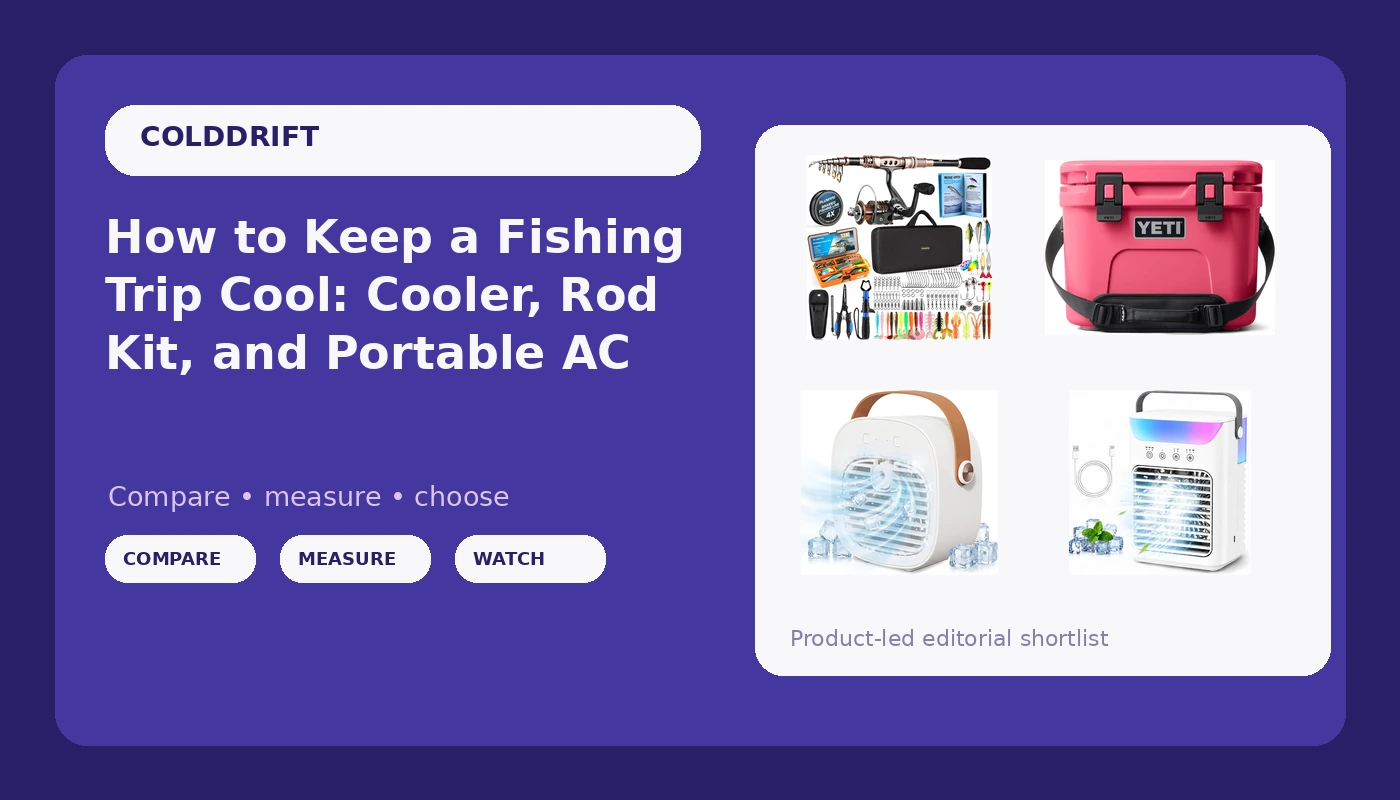
A July fishing trip is a heat problem in three parts. The catch has to stay cold from the net to the kitchen. The truck cab turns into an oven between launches. And whatever you sleep in, tent or motel room, has no moving air after dark. Most people solve one of those and call it handled, then find out on day two that the ice is water and the fish is warm.
Fishing trip cooling gear works better when you split it that way: ice retention, packability, and powered airflow. The four products below cover those three jobs at very different sizes. None of them does another's job, and choosing wrong is usually a matter of buying for the trip you wish you were taking instead of the one on the calendar.
Related: Rotomolded vs Injection-Molded Coolers: What the Shell Actually Does →
Quick answer
If you only fix one thing, fix the ice. A hard-sided cooler with a clean sealing gasket handles the catch, the drinks, and the leftovers, and it is the only item here that fails a trip outright when it fails. A telescopic rod kit keeps the fishing side small enough that the cooler gets the room it needs. The two small powered coolers are airflow tools for the cab, the tent, or the desk, and they earn their space only after the ice is handled.
Four useful options
| Model | Best fit | What stands out |
|---|---|---|
| YETI Roadie 15 Hard Cooler with DoubleDuty Shoulder Strap | Short trips where one person carries the load | Hard-sided YETI build with a shoulder strap for hands-free hauling |
| PLUSINNO Fishing Rod and Reel Combo with Telescopic Fishing Pole | Travel and pack-in fishing | Collapsible pole, reel, tackle box, and carrier bag in one kit |
| Mini Air Conditioner, 6000mAh Rechargeable Portable AC for Car | Truck cab, tent, and car camping | 6000mAh rechargeable battery with three speeds and a cool air spray |
| Portable Air Conditioner Desktop AC Cooling Fan, 1500ml | Desk, bedroom, and small enclosed spaces | 1500ml tank, three wind speeds, eight color lights, and a 2 to 6 hour timer |
The hard cooler: YETI Roadie 15 Hard Cooler with DoubleDuty Shoulder Strap
Where this fits: on a half-day or a single overnight, a small hard cooler is the honest answer. Size honestly, because a cooler you cannot lift when it is full is a dock ornament. This is the one you carry to the boat, not the one you leave in the bed because it got too heavy. The trade-off is capacity. A cooler this size holds the day's catch and the drinks, and it is not the box you pack for a three-day run with four people.
The rod kit: PLUSINNO Fishing Rod and Reel Combo with Telescopic Fishing Pole
Where this fits: the point of a telescopic kit is space. Every foot of truck bed you give to a one-piece rod is a foot you cannot give to ice. If fishing is a side activity on a family trip or a quick shore lunch, a collapsible kit keeps the cooler as the priority. The trade-off is the usual one for telescopic rods: more joints means more places to check before you cast, and a kit rod is not the tool for heavy cover or big water.
The rechargeable spot cooler: Mini Air Conditioner, 6000mAh Rechargeable Portable AC for Car
Where this fits: set expectations correctly and this thing is useful. A unit this size moves air across a small area and adds a spray feature; it does not drop the temperature of a truck cab the way a compressor does. That is fine, because the job here is the twenty minutes before you fall asleep in a motel room, or the gap between launching and driving home. The rechargeable battery is the real selling point, since the outlet is often in the wrong place.
The desktop cooler: Portable Air Conditioner Desktop AC Cooling Fan, 1500ml
Where this fits: the larger tank is the difference between this and the battery unit. More water means longer runs between refills, but it also means the thing wants to sit flat on something stable rather than ride on a seat. The timer is the genuinely useful feature on a trip, because you can set it, fall asleep, and not wake up to a dry tank and a running fan. The lights are a novelty, not a reason to buy.
Prices and availability may change. Product images, names, and retailer links must be matched by verified ASIN. Do not state a current price, rating, stock status, or measured result without current evidence.
Why ice retention is the only spec that matters
Ice retention is days of usable ice with real-world opening, and it is the number that decides whether a trip works. A cooler that holds ice for four days and a cooler that holds ice for one can look identical on a shelf. What separates them is the lid seal, the shell construction, and how often you open the thing.
The gasket is the whole game. A rubber seal that sits flat and clean against the rim keeps cold air in and warm air out. A gasket that is warped, pinched, or coated in dried drink residue is a cooler that lies to you. Run a finger around the rim before every trip. If the lid does not resist slightly when you set it down, the seal is not doing its job.
Shell construction matters next. Rotomolded shells are formed as a single piece, which is why they survive boat decks and rough roads. Injection-molded shells are lighter and cheaper and perfectly adequate for a picnic. Neither one beats a good gasket and a lid you keep shut.
How to read a portable cooling claim
The phrase "portable air conditioner" covers two very different machines. A true air conditioner has a compressor and refrigerant and moves real heat out of a space. An evaporative cooler pulls air across water or a wet pad and drops the temperature a few degrees while raising humidity. Both get listed the same way, with the same words.
The clues are in the specs. A compressor unit is heavy, needs a vent, and usually needs wall power. A personal cooler lists a battery capacity in mAh, a tank in milliliters, and a set of fan speeds. Those numbers describe runtime and airflow, not how many degrees the unit removes.
Battery capacity tells you how long it runs. Tank size tells you how long between refills. Wind speeds tell you how much air you get. None of them promise that the unit will chill a hot truck cab in ten minutes, and a listing that implies otherwise is overselling a fan.
- Count nights, not people. Ice math follows trip length far more than headcount.
- Decide who carries the cooler when it is full, then buy to that weight.
- Budget the space. If a one-piece rod eats the room, a telescopic kit buys back ice capacity.
- Solve airflow separately from ice, with a powered unit, instead of opening the cooler for a breeze.
- Before you leave, check the gasket, the drain plug, and the latches on a flat surface.
Practical guidance for the trip itself
- Chill the cooler the night before with a bag of ice you plan to dump anyway.
- Use block ice for the base and save cube ice for drinks.
- Keep the cooler out of direct sun and off hot metal. Shade buys you hours.
- Open once, take everything, close it. Every open costs minutes off the log.
- Run a second small cooler for drinks so the food cooler stays shut.
- Charge the battery-powered coolers at the outlet, not in the truck.
Which option should you choose?
Choose the YETI Roadie 15 Hard Cooler with DoubleDuty Shoulder Strap when your trips are short and one person does the carrying. Choose the PLUSINNO Fishing Rod and Reel Combo with Telescopic Fishing Pole when fishing is part of the trip but not the whole truck bed. Choose the Mini Air Conditioner, 6000mAh Rechargeable Portable AC for Car when you need airflow somewhere with no outlet nearby. Choose the Portable Air Conditioner Desktop AC Cooling Fan, 1500ml when you have a flat surface and a power source, and you want a timer doing the work after you fall asleep.
None of these are substitutes for one another, and none of them has a published ice log or measured cooling result behind this article. Check the current listing for each product, confirm the dimensions against your own space, and read the return policy before you commit.
The bottom line
Cooling a fishing trip is three purchases pretending to be one. The cooler does the cold work, and it is the only piece that ruins the trip when it fails, so the gasket and the seal get your attention first. The rod kit is about giving the cooler room. The two small powered coolers handle the air, and they are worth owning once the ice is already solved. Buy the cooler for the trips you actually take, size it to who carries it, and let everything else stay small.